Showing posts with label onomastics. Show all posts

2010-05-04

Chronicle of Hippolytus

This has not been one of the major reasons for my latest blog detox, but I've become involved in a translation project, which has cost me a few evenings and will cost me a few yet.

Tom Schmidt has worked on a translation of Hippolytus' Chronicle—a text I'd already noticed in my TLG work because of its morass of unknown proper names. I've helped Tom revise the translation, and he has just posted the second edition on his blog. There will be a third edition sometime over the next couple of months, which will deal with why I was interested in the text in the first place. And somewhere in there, there will be Cool Google Earth tricks.

Let me take things from the start.

Hippolytus' Chronicle was written in 235 AD. Chronicles as we know them are informal bits of history, assembled around the scaffolding of reigns of kings, and plot synopses of the narrative from Genesis up to the Roman Empire. Hippolytus provides some of that scaffolding, from the Biblical side, as one of the first Christian forays into writing history: lists of high priests, judges, the begats of Adam and Abraham, and the list of the 70 peoples dispersed at Babel (with some post-Genesis interpretations of who those peoples had ended up as).

The list is garbled from the Septuagint in places: in fact the second redaction of the chronicle, written a century later, corrects some of the garblings. But the chronicle (in its slightly corrected variant) was enormously influential: its lists turn up at the beginning of tens of chronicles, in Greek, Latin, and Armenian. In fact these later copies help us reconstruct the original text, since the surviving text closest to Hippolytus' original, the Madrid manuscript, still has gaps in it.

The Madrid manuscript also includes a text absent from all other versions: a mariner's guide to sailing the coast of North Africa, and a (possibly distinct) guide to Syria, Asia Minor, Cyprus, and Crete. This text is known as the Stadiasmus or Periplus Maris Magni: "The Measurement In Stades, Or Circumnavigation Of The Great Sea, videlicet, The Mediterranean."

The Periplus is not attributed to Hippolytus, and indeed it may not even have been Hippolytus himself who included it in the chronicle text. But someone saw its huge list of place names, and thought it would fit right in with Hippolytus' begats and lists of peoples. It was published by Müller in 1855, before Hippolytus' Chronicle proper, but the text is still included in Helm's 1955 edition.

As you can see from our rendering (or the Latin or Greek in Müller's edition), the Periplus lavishes attention on every little nook of the African coastline: its approach to Asia Minor is more summary, which is why Helm thinks it conflates two separate itineraries. But as the discussion in the Barrington Atlas explains, its excruciating detail is not because sailing North Africa was a pleasure cruise. The route had huge commercial importance, and Egypt was still the breadbasket of the empire; but the coast was sparsely populated, dangerous, and parched. That's why the Periplus spends so much attention on where to find water. And why mariners had to know the tertiary (III) meaning of the adjective πλατύς: πλατὺ ὕδωρ was not "broad water", but "brackish".

Hippolytus' Chronicle attracted my attention in my TLG work, because I'm ever on the lookout for unfamiliar proper names, and the Chronicle has them aplenty, between every single port in North Africa, and the twisted tribal names of the Caucasus or Libya. (Hippolytus' Taramantes are the Garamantes, for example: tau looks a lot like a gamma.) So I was eager to help out with working the names out, with reference to the secondary literature: the Barrington Atlas, Smith's much older (but freely online) Geographical Dictionary, and Müller's edition—which was much bolder than Helm in meddling with the Periplus' placenames, to match Ptolemy and Strabo.

The version we've just put up has not done that work yet: in fact you can tell where I left off footnoting. It's a big job, with several sources to check, and we didn't want to hold off making it available until it was perfect. That's not the way publishing works on the Intertubes, after all: early feedback is good, and all that. We will go back over the place names in the next month or so.

The major task in doing that will be to reconcile the placenames of the Periplus with the persistent identifiers of the Pleiades project, drawn from the Barrington Atlas, which is how we'll find the canonical form of the place names. (More on those identifiers here and here.) That way—to reconcile my day job with my other vocations—we can harness URIs to draw references from classical texts into the Semantic Web, and the other goodies that the Web now makes possible. Such as plotting the Periplus onto Google Earth. (Cf. the geocoded Bible on Openbible.info.)

But that's for the next month or so; the place names are still left buggy for now, but any and all feedback is welcome. Please leave comments over at Tom's blog if you do have feedback.

2009-10-05

Nastratios in Pagdatia

A thread last month at the Magnificent Nikos Sarantakos' Blog, about insulting commentary on a candidate MP from the Muslim minority, got derailed in comments (the way good comment threads do) into a discussion of whether there was any point teaching Ancient Greek in high school in Greece. The reason why Ancient Greek is taught in high school has to do with moral panic, rather than any concern over actually learning the language. That is why the age at which it is taught has become such a football; and the way Ancient Greek is taught is universally condemned.

Indeed, most commenters thought teaching Ancient Greek language at the expense of Ancient Greek literature *as literature* was unacceptable, and teaching Ancient literature in translation, as has occasionally happened, is much preferable. Some commenters conceded the usefulness of Ancient Greek in teaching grammar, but grudgingly. And I'll stay with this exchange:

Ηλεφούφουτος: ... Instruction should not give so much emphasis on reproducing grammatical forms (e.g. what is the 3rd person imperfect of ὑφίημι, or conjugate the verb in the second aorist middle optative.) All that, and syntactic parsing word for word, are fine brain exercises, but that's now how you'll learn Ancient Greek.

Μαρία: Who gives a f*ck about reduplication. But for students to recognise that this is a verb, an adjective, at least the parts of speech: that much is necessary. So they must be taught grammar, and you can't do that with little songs and little poems. Have you forgotten this isn't a living language?

I'm not contributing to that derailment—although I agreed there it was absurd that the students weren't being asked questions about the literary values of Antigone. In fact, the recommendations Ηλεφούφουτος was citing included "don't teach Ancient Greek through Antigone, you'll ruin Antigone for the kids." But I'm doing my own derailment, with the notion of little songs and little poems in learning Ancient Greek—that is, of teaching Ancient Greek in the engaging way schoolchildren learn foreign languages.

There is a textbook that does that: Paula Saffire & Catherine Freis. 1999. Ancient Greek Alive. 3rd ed. Chapel Hill: University of North Carolina Press.

Ancient Greek Alive has students act out skits, it has them doing question and answers with the teacher in Ancient Greek, and it has little stories in the target language, rather than starting with Real Text. In other words, it does what you normally do nowadays when you teach a foreign language. It would never ever be used in Greece, not only because of the profound malaise of Greek education, but because the relation of Greeks to their antiquity has always been too po-faced. It's the same reason, as I've posted in The Other Place, why a Greek will never affectionately parody their national anthem the way the Dutch do; and why a pastiche like Geoffrey Chaucer Hath a Blog will not lead to a Ἱστολογίζει Θουκυδίδης blog or a Λουκιανοῦ Διαδικτυακτοὶ Διάλογοι blog. At least not by a Greek.

(I beg someone to prove me wrong.)

I was reminded of Ancient Greek Alive because the earliest little texts it puts to the student are nothing to do with Ancient Greece. They are translations of tales of Nasrudin. Nasrudin is a comic figure from the Sufi tradition, who has made it into the folklore of many Muslim countries and their neighbours. His humour is somewhat subversive, and delightfully absurdist.

One of the neighbouring peoples Nasrudin's japes have gone across to are the Modern Greeks. He survives more in Cyprus than in Greece, but his humour has remained proverbial, in "the argument over the blanket" if nothing else—which has become a journalistic cliché. Nikos Pilavios' Greek Fairy Tale blog (I vaguely remember watching his TV show when I was a kid) has 36 Nasrudin tales, and an article about his own discovery of Nasrudin. Not all the tales are authentic, but authenticity doesn't mean that much with fairy tales. The journalistic cliché instance of a Nasrudin story, however, has been contributed there by a commenter:
Ενα βράδυ ο Ναστραντίν Χότζας κοιμόταν με την γυναίκα του. Ξαφνικά ξύπνησε από τις φωνές δύο ανθρώπων που καβγάδιζαν κάτω από το παράθυρό του. Σηκώθηκε, τυλίχτηκε στο πάπλωμα και κατέβηκε να δει τι συμβαίνει. Μόλις αυτοί τον είδαν, παράτησαν τον καβγά, άρπαξαν το πάπλωμα και έγιναν καπνός. Οταν η γυναίκα του τον ρώτησε γιατί καβγάδιζαν, της απάντησε: «Ο καβγάς ήταν για το πάπλωμα».
One evening Nastrandin Hodja was sleeping with his wife. Suddenly he woke to the shouting of two men arguing beneath his window. He got up, wrapped himself in his blanket, and went downstairs to see what was happening. As soon as they saw him, they quit arguing, grabbed the blanket and disappeared. When his wife asked him why they were arguing, he answered: "the argument was over the blanket".

Have you noticed what's happened to the name Nasrudin? It starts in Arabic as نصرالدين naṣr ad-dīn, "Victory of the Faith", which is a Muslim proper name. In Turkish, it's Nasreddin Hoca, Teacher Nasreddin. Greek now respectfully transliterates him as Νασρεντίν <Nasrentin>; but spoken Greek had no patience for /sr/ clusters, so traditionally he has been called Ναστραντίν Χότζας, <Nastrantín Chótzas>, with an epenthesis breaking up the /sr/.

I was reminded of Nastrantin, not because of the thread over at Sarantakos', but because I came up against the name in a different context. I've been going through the Prosopographisches Lexikon der Paläologenzeit, the Who's Who of Late Byzantium; and I've found that George Pachymeres mentioned a Nasreddin Mahmud, son of Muzaffer ed-din Yavlak Arslan, who died in the battle of Bapheus in 1302. Because written Greek had no patience for /sr/ clusters either, he is rendered as <Nastrátios>, with the same epenthesis:
Ἁλῆς γὰρ Ἀμούριος σὺν ἀδελφῷ Ναστρατίῳ τῷ παρὰ Ῥωμαίοις ἐπὶ χρόνοις ὁμηρεύσαντι, τοὺς περὶ τὴν Καστάμονα Πέρσας προσεταιρισάμενος, Ῥωμαίους κακῶς ἐποίει.
For Amurios Hales ["Amur" Ali Bey], with his brother Nastratios who had been a hostage with the Romans for years, joined the Persians [Turks] around Kastamon [Kastamonu], and did ill to the Romans. (p. 327 Bekker)

Hold on to that Hellenisation as <Nastratios>, we'll come back to it. It gets worse in the Palaeologan Prosopography, btw. Ducas mentions a Χατζιαβάτης, Haci Aivat. Not the same person as the Hacivat of Turkish shadow puppetry, but certainly the same Hellenisation in its Greek counterpart.

What possessed Paula Saffire to insert a Sufi jokester into an Ancient Greek textbook? You can read all about it at her website. The notion of a Turkish jokester turning up in an Ancient Greek textbook is, I think you can safely surmise, a notion some Greeks are likely to have issues with: one more reason you won't see Ancient Greek Alive taken up in Greece. More's the pity.

So far, I've cited Nastrantin in Modern Greek, and a different Nastratios in Byzantine Greek, but I haven't shown you how Saffire & Freis Greek Nasruddin in the textbook. Here's his first appearance, p. 28:
ἄνθρωπός τις βούλεται πέμπειν ἐπιστολὴν ταῖς ἀδελφαῖς ταῖς ἐν τῇ Βάγδαδ. ἀλλὰ οὐκ ἐπίσταται γράφειν τὰ γράμματα. αἰτεῖ οὖν Νασρέδδινον τὸν Σοφὸν γράφειν τὴν ἐπιστολήν. ὁ δὲ Νασρέδδινος λέγει αὐτῷ· «ὦ φίλε, οὐκ ἐθέλω γράφειν τὴν ἐπιστολήν. οὐ γάρ ἐστί μοι σχολὴ πορεύεσθαι εἰς τὴν Βάγδαδ.»

ὁ δὲ ἄνθρωπος λέγει «ἀλλὰ οὐκ αἰτῶ σε πορεύεσθαι εἰς τὴν Βάγδαδ. αἰτῶ σε μόνον ἐπιστολὴν γράφειν ταῖς ἀδελφαῖς μου.»

«οἶδα» ἀποκρίνεται ὁ Σοφὸς· «ἀλλὰ ἡ γραφή μου κακή ἐστι καὶ ἀνάγκη ἂν εἴη μοι πορεύεσθαι εἰς τὴν Βάγδαδ καὶ ἀναγινώσκειν αὐταῖς τὴν ἐπιστολήν.»

A man wants to send a letter to his sisters in Baghdad. But he does not know how to write the letters. So he asks Nasreddinos the Sage to write the letter. But Nasreddinos says to him: "Friend, I do not want to write the letter. I don't have enough time to go to Baghdad.

The man says, "but I'm not asking you to go to Baghdad. I'm only asking you write a letter to my sisters."

"I know," the Sage answers. "But my handwriting is bad, and I would have to go to Baghdad myself and read the letter out to them."

You may have noticed some things wrong. No, they have not taught the aorist yet, so everything is in the present tense; that's understandable, though it makes the story sound Pontic. (No, not Pontic as in the butt of Greek jokes, but as in the dialect that fails to make any aspect distinctions in the subjunctive.) I'm also not sure that's how you'd use οἶδα. But no, there's something wrong with the transliteration.

Not that they failed to use <Nastratios>: it would hardly be fair to ask that of them—although the fact that they, like contemporary Greeks, have patience for /sr/ clusters puts them at odds with what a Greek writer would actually have done.

But what sticks out, as many a Greek will tell you, is Βάγδαδ <Bágdad>. Greeks do not call Baghdad Bagdad /ˈvaɣðað/. They call it Βαγδάτη, <Bagdátē> /vaɣˈðati/. And they will become righteously indignant, as indeed I did when I bought the book. We met Iraqis centuries before the Beef-Eaters—and Theophanes Confessor called them Hērakîtai, Ἡρακῖται. Where do Saffire & Freis get off, ignoring what Greeks call Bagdad, and coming up with their own name? Don't we matter? Don't the Byzantines, who dealt with Bagdad, matter?

The sentiment has a certain sense behind it; to call Russians Ῥοῦσσοι instead of Ῥῶσσοι, as they do elsewhere (moving on to an anecdote about Napoleon) does seem a little disrespectful of Constantine Porphyrogenitus.

But I've already written a post on how Modern Greek Hellenisations are more antiquarian than Byzantine Hellenisations were. So how did those Byzantines actually call the city?
  • Theophanes Confessor (ix AD): Bágda
  • Apomasar (ix AD): Bagdân
  • Leo Choerosphactes (x AD): Bagdá
  • Constantine Porphyrogenitus (x AD): Bagdád
  • Theophanes Continued (x AD): Bagdá, Bagdád
  • Anna Comnena (xii AD): Bagdâ
  • John Scylitzes (xii AD): Bagdá
  • John Zonaras (xii AD): Bagdâ
  • Digenes Acrites (xiv AD): Bagdâ
  • Laonicus Chalcocondyles (xv AD): Pagdatíē, Pagdátin
  • Vernacular Astrological texts, Delatte: Codices Athenienses (? AD): Bagdádai, Pagdáti

The accentuation Βάγδαδ has never been correct: Saffire & Freis have carried across the Germanic stress position of English /ˈbæɡdæd/, whereas all but the first Greek transliteration reflect the stress of the Arabic بغداد‎ /baɣˈdaːd/.

But it turns out there is nothing Byzantine about the modern feminine form Βαγδάτη. The Byzantine forms are either variants of the feminine Βαγδά, the neuter Παγδάτι, or the quite indeclinable Βαγδάδ, with the hesitation between <b> /v/ and <p> /p/ typical of Late Byzantium. (Chalcocondyles' Homeric rendering of "Bagdadia", Παγδατίη, is the kind of affectation we'd expect of him.) I couldn't find out from my quick-and-obvious search when Βαγδάτη was first used, but it doesn't seem to be have been used by those who met Iraqis centuries before the Beef-Eaters.

Attempts to write Ancient Greek in Modern times, à la Neo-Latin, don't have a convenient name, through which the Ancient Greek Wikipedia can be banned by the Wikipedia Language Committee (grumble stick-up-their-arses grumble as-if-anyone-uses-Low-Saxon-as-a-primary-language-of-communication grumble grumble). We can't call them Neo-Greek, Neohellenic is what Modern Greek is called. Neo-Classical goes to Stravinsky—or Puristic. Neo-Attic is too specific, it leaves out the Astronautilia. Neo-Ancient?

Whatever it's called, Neo-Ancient Greek when it happens is indebted to Puristic: the Ancient Greek Harry Potter doffs its hat to 19th century dictionaries (and shies away once Demotic turns up in the lexica). The Neo-Ancient Greek Asterix doesn't doff its hat, admittedly. Then again, the Neo-Ancient Greek Asterix doesn't have to: it was translated in Greece (ingeniously), and Puristic seeps in there through the soil.
(The linked post notes that Asterikios in Ancient Greek didn't work well with Grade 7 students, who still struggled with the language—but that it did work when accompanied by the Modern Greek text in parallel. While we're on the subject: two interviews with the translator of Asterix into Ancient Greek, Fanis Kakridis: #1, #2.)

Saffire & Freis did not doff their hat to Puristic either, in telling tales of Napoleon or Nasrudin—even through they drafted the textbook on a beach in Crete. (Maybe Puristic doesn't seep through sand.) So their Russians are Ῥοῦσσοι instead of Ῥῶσσοι, because of English Russian, and their Nasrudin is Νασρέδδινος because of Turkish Nasreddin, not Modern Ναστραντίν. (It would have been unreasonable, I admit, to demand of them Mediaeval Ναστράτιος.)

In not writing Βαγδάτη, though, it wasn't the Byzantines they didn't doff their hat to, it was Puristic, and by extension Modern Greek. But of course, when Harry Potter uses Puristic words, it isn't because of love of Coray and Papadiamantis. It's because that's where he's going to get a word for train more compatible with Ancient Greek than the contemporary τρένο. Saffire & Freis had no such compulsion with Modern names.

The failure to epenthesise <Nasréddinos>, I'd still say, is a lack of sensitivity to Ancient Greek as a spoken language, which is ironic given how oral their textbook is. But the extremely unpleasant truth is, an American textbook of Ancient Greek owes Modern Greek speakers even less than it does to Constantine Porphyrogenitus. It doesn't owe them Βαγδάτη just as it doesn't owe them iotacism.

Still, if it owes the Hērakîtai anything, it's not Βάγδαδ. Like Constantine Porphyrogenitus said: it's Βαγδάδ.

P.S. Saffire has made the mistake of saying on her website: "Surely these are the only Sufi stories in ancient Greek!"

Them's fighting words:
ἀφικόντος γείτονος ἐπὶ τῆς πύλης Ναστρατίου τοῦ ἱερέως, ἐξέρχεται ὁ ἱερεύς ὑπαντῆσαι αὐτόν.
«δός μοι, ἱερεῦ, τὸν σὸν ὄνον σήμερον», αἰτεῖ ὁ γείτων. «ἔχω γὰρ ἀγαθά φορτία τινα μετακομῆσαι εἰς τὴν ἄλλην πόλιν.»
ὁ μὲν Ναστράτιος οὐ βούλεται δοῦναι τὸ κτῆνος οὕτῳ τούτῳ· ἵνα δὲ μὴ ἄξεστος φανῇ, ἀποκρίνεται·
«σύγγνωθι, ἀλλ’ ἤδη δέδωκα τὸν ὄνον ἑτέρῳ.»
αἴφνης ἀκούεται ὁ ὄνος ὀπίσω τοῦ τείχους τῆς αὐλῆς ὀγκώμενος.
«ἐψεύσθσης μήν μοι ἱερεῦ!» φωνεῖ γείτων. «ἤν, ὀπίσω τοῦ τείχους!»
«ποῦ δαὶ τοῦτά φῃς;» ἀποκρίνεται ὁ ἱερεύς βριμώμενος. «τίνα δὴ μᾶλλον πιστεύσεις, ὄνον ἢ τὸν σὸν ἱερέα;»

A neighbour comes to the gate of Mulla Nasrudin's yard. The Mulla goes out to meet him outside.
"Would you mind, Mulla," the neighbour asks, "lending me your donkey today? I have some goods to transport to the next town."
The Mulla doesn't feel inclined to lend out the animal to that particular man, however; so, not to seem rude, he answers:
"I'm sorry, but I've already lent him to somebody else."
Suddenly the donkey can be heard braying loudly behind the wall of the yard.
"You lied to me, Mulla!" the neighbour exclaims. "There it is behind that wall!"
"What do you mean?" the Mulla replies indignantly. "Whom would you rather believe, a donkey or your Mulla?" (via Wikipedia)

I welcome chastisement of my Neo-Ancient Greek in comments. Well, chastisement within reason...

[EDIT: I got better than chastisement from William Annis; I got an improvement. In iambics after Babrius. I'd pardon his violation of Porson's Law, but my command of Ancient Greek is so lacking—let alone metrics—that I cannot but reverently cede the floor to him:]

γείτων τις αὐλῆς ἦλθε Ναστρατίου πύλην,
ὁ δ’ ἐκτὸς ἦλθεν ἀσπάσασθαι γείτονα.
“βούλοι’ ἂν, ἱερεῦ,” δεόμενος ἔφη γείτων,
“τῇδ’ ἡμέρᾳ μοι τὸν ὄνον ἐνδοῦναι τὸν σόν;
εἰς γὰρ πόλιν πρόσοικον ἐμπολὰς οἴσω.”
ἀλλ’ οὔτ’ ὄνον βουλόμενος ἐνδοῦναι κείνῳ,
οὔτ’ εἰκέναι γ’ ἄγροικος, ἠμείφθη λέγων,
“σύγγνοιαν ἴσχ’, ὦ γεῖτον, ἄλλῳ γὰρ πόρον.”
τείχους δ’ ὄπισθ’ ἔκλαγξεν ὄνος εὐθὺς μέγα.
“ἔψευδες ἄρα μοι,” φὰς ἐβόησεν γείτων,
“ὧδε γὰρ ὄνος πάρεστι!” ἱερεὺς δ’ ἤχθετο·
“πῶς οὖν λέγεις,” ἔλεξε, “τίνι δῆτα πείθου;”
...Read more

2009-09-23

Kozani: a stab at etymology

Language Hat asks in comments to the previous post about the Wikipedia etymologies of Kozani:
According to prevailing opinion, the name comes from the village of Epirus Kósdiani, the origin of settlers of Kozani in 1392. The settlement was first named Kózdiani, which then, it was changed into Kóziani, and in the end into Kozáni.[2]

The name "Kozani" probably may also derive from the South Slavic kožani < koža 'skin (goatskin)'.[3] The name of the city in South Slavic languages is Кожани (Kožani).

Am I wrong in thinking the Slavic etymology makes much more sense than the first one, with its strained reshapings? (We won't even get into what "probably may also" is supposed to mean.)


As often happens in Wikipedia, it's two opinions barely reconciled together on the same page. Now, Googling is no surrogate for actually knowing Slavonic (or Albanian), but let's see how I can help. (Damn you, Language Hat, I was supposed to be doing my taxes!)

The "Hellenic" etymology is sourced from the website of the city of Kozani, which as you'd expect wouldn't be eager to point to the parallel with that language. (Kozani prefecture turns out to be the furthest spread south of Slavonic in Modern times, with Greek and Slavonic villages mixed.)

[Non-Greeks will notice that I speak vaguely of Slavonic, when we all know *which* Slavonic language I'm talking about. But I'm not feeling like getting into needless argy-bargy with those of my readers who don't want to call it "Macedonian"; and since I'm talking about 1400 and not 1950, I may just get away with it...]

The thing is, Kozdiani may not look like Кожани, but it doesn't look particularly Hellenic either. Is there any way Kozdiani could originate from the same Slavonic form as Kožani? Although given it's Epirus (Northern Epirus, as it turns out), and given the names of the other villages cited below, Albanian is more promising as an etymology.

This is what the Kozani city website has to say:
In 1392 colonists from Premeti, Bithikukio, and Kozdiani of Epirus {Përmet and Vithkuq, Albania}, fled chased away by Muslim Albanians to the region north of Selitsa {Selitsa, now Eratyra, Greece}, which is to this day called Old Kozdiani, and subsequently migrated eastwards, encountering the Christian settlement of Kalyvia. {The quite Hellenically named "Huts"; I've found one near Konitsa, on the Greek side of the border.}

The inhabitants of Kalyvia did not reject them, but they obliged them to build their houses further east. The new inhabitants called the region Tzamouria {i.e. Çamëria), preserving the name of their old region.

Nowadays the region is called Tzambra. {[dzamurˈja] > [dzamˈrja] by high unstressed vowel deletion > [dzamˈbra] > [ˈdzambra]}. They called the rocky hill over Tzambra Skrika or Skirka (Sk'rka), which means a rocky elevation.

Though there are different opinions of where the city name came from, the dominant opinion is that these colonists from Epirus called the new settlement Kósdiani, which then became Kóziani, and later scholars [i.e. in Puristic Greek] transformed it to Kozáni.

A few years later families from Servia {town in Greece} and Drepano move to Kosdiani, augmenting it.


From another site: "People speculate that the name Kozani is due to either the place of origin of its first inhabitants, Kosdiani or Kostiani in Epirus, or their main occupation of tanning: "coza" in Epirot means goatskin." Tellingly, coza is given in Latin script, which you'd be unlikely to do if "Epirot" here meant "the Greek dialect of Epirus".

The account derives from a 1924 history of Kozani, cited at this blog:
The name of the folklore group (Kóziani), stressed on the antepenult, shows a hardy genuineness, like the hulls of Sk'rka (Slavic: rocky protuberance; Albanian: hill). And given the opportunity: the definitive interpretation of the name of the city is stilll under research. I'm opening up the History of Kozani by P. Lioufis, Athens 1924.
  • The first inhabitants of the region one day saw ... a she-goat running through the trees, and called the village Kózani or Kóziani; for kóza means a she-goat, and kózia a skin in "Bulgarian".
  • Above the town of Selitsa (Eratyra) there is a region in its mountains called Kóziani, or rather Old Kóziani, where those pursued from Northern Epirus first settled, from the villages there of Kosdiani and Bithikukion. (The latter exists to this day.) Then they came to the region of Paliospita where the Kasmirtzidis Society have their establishment, as do many other settlers in the area, genuine or not.
  • The Turks called the town Kózana, from Koz ("walnut", or Kákhta in pure Kozani dialect) and Ana "mother", for the multitude of walnuts there.


And here's a map of Përmet, Vithkuq, Kalyvia, Selitsa (now Eratyra, near Askion), Kozani, and Servia:

View Kozani in a larger map
At least one site says that the original Kozdiani was destroyed, which is consistent with Lioufis' wording

So what do we make of all this?

  • The Turkish is a folk etymology, and nothing wrong with that.
  • Kozáni may be named for Kózdiani, but it's quite possible that both are named for the Slavonic for "goat"; Lioufis certainly assumed so.
  • Kózdiani is in Northern Epirus, i.e. modern Southern Albania; Albanian and Slavonic are both possibilities for etymology, and Albanian and Slavonic would both have been trading words anyway (as appears to be the case with "Sk'rka")
  • Tzamouria i.e. Çamëria is the name of Southern Albania, although we don't know from this whether we actually have a record of the area around Kozani being called that at the time—which would confirm migration from Southern Albania—or whether this was Lioufis' etymology of modern Tzambra. All of the Tzamouriá > Tzámbra etymology is plausible, except for the stress shift.
  • I'd like to know more about Lioufis's sources, because the Greek Wikipedia article then adds that the first written reference to Kozani is in a firman of 1528.
  • I think 1392 is a little early for religious conflict in the Western Balkans—the reference is to τουρκαλβανοί, Muslim Albanians not τούρκοι. But I could be wrong. *shrug*
  • "The inhabitants to Kalyvia did not reject them, but" they kicked them out anyway.
  • I'm not at all convinced that the stress shift of Kóziani to Kozáni is a learnèd thing. Sure Kóziani violates ancient accentutation (because Κόζιανη looks like being stressed four syllables from the end—until you realise it's [ko.zja.ni], but Ancient Greek did not have ι as [j]). But I'd have expected a learned form to go with Kozíanon, rather than preserve the feminine gender. And as Don Hat correctly noted, phonologically the shift from Kósdiani to Kozáni does seem a little forced.
  • So the derivation of Kozáni from Kósdiani has problems. But as it turns out, both Kozáni and Kósdiani seem to have a Slavonic origin anyway, so it's a distinction that doesn't matter.


So, that's what googling tells me. If anyone actually knows any Albanian, Macedonian [there, I said it], or Greek dialect and can contribute, you'll be doing the world a favour. Particularly if they can explain the accentuation of Kozáni.
...Read more

2009-09-18

Lascaris Cananus: Updated

Well, I now have both the Lundström and the Blomqvist editions of Lascaris Cananus next to me, so I can update my preceding post on him.

Thanks to your intrepid correspondent, the 1902 edition, Lundström, Vilhelm (ed.) 1902. Laskaris Kananos. Reseanteckningar från de nordiska länderna. Upsala; Leipzig: Lundequist (Smärre Byzantinska skrifter; 1)—is now online at archive.org.

The 2002 edition—Jerker Blomqvist 2002. The Geography of the Baltic in Greek Eyes. In Amdem, Bettina et al. (eds), Noctes Atticae: 34 articles on Graeco-Roman antiquity and its Nachleben. Copenhagen: Museum Tusculanum. 36-51—is on Google Books, which skips a couple of pages:


The text appears in a scrapbook kept by Gemistos Plethon on the geography of the north. The early Scandinavian scholars took Kananos at face value, flattered that a Greek bothered to talk about their countries, and pardoned his occasional exaggerations—no, the day in Bergen is not a month long, Bergen ain't Finmark; and yes, they had money in Bergen by 1439.

A hundred years on, people are more sceptical; or at least, Blomqvist is. He finds that Cananus manages to simultaneously place Norway at the western extreme of the Baltic Sea, and East of Lithuania. He concludes Cananus did not go to Scandinavia; instead, he pieced together his account from contemporary mariners—presumably Italian, given the flavour of the place names; and Ptolemy. Mediterranean sailors had been monopolised out of the Baltic by the Hansa, so their information on the Baltic was sketchy—they all thought the Baltic was sausage-shaped. But their knowledge was still better than Ptolemy, who had first called it the Wenedic sea—and who thought Scandinavia was some island vaguely around Poland.

Cananus *may* have gone to Iceland, although Lundström notes his description of Iceland is a lot like that of mediaeval Englishmen:
Cananus: And I saw men strong and sturdy; and their food was fish, and their bread was fish, and their drink was water.
Eulogium Hist. IV 105: Whence the whole island lives in common off fish, the hunt, and meat for the most part. ... That people is quite thick-set, robust, and quite pale, dedicated to fishing and the hunt.
Ranulph. Higden. Polychr. I. 31: Iceland ... has a people that is taciturn, truthful, covered in furs, and given over to fishing.


The date of 1438–1439 comes from how Cananus describes the administration of Livonia: the central administration of the Teutonic Knights had briefly taken over the running of Riga. Blomqvist is not sure Cananus knew the difference between "under the control of the Duke of the Grand Master of the white robes and black cross", and "under the control of the Duke, of the Grand Master of the white robes and black cross"—i.e. whether the Duke is the Grand Master, or the Grand Master's deputy.

The bit in Cananus that Greeks as opposed to Scandinavians care about is the association of Lübeck with the Zygiotai. Since we can now second guess Cananus, I go back to Jakob's remark that 1400 is a bit late for Lübeck to be Slavic speaking, and I'll also note that there's a country missing in Cananus' list: it wasn't on the Baltic back then, but we can no longer trust Cananus realised that. Lübeck is supposed to be the capital of Sthavonia (which is how the manuscript spells it), and noone disagrees that he means Sthlavonia, "Slavic Country". I think Cananus thought Lübeck was in Poland.

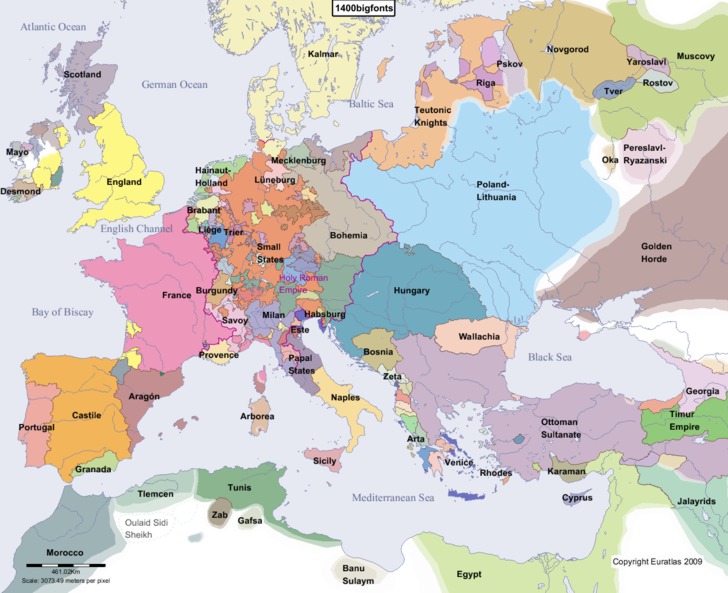
To finish with Cananus' geographical missteps, this is a map of Europe in 1400 according to Christos Nüssli's exceedingly cool Euratlas Historical Map of Europe:

Wikipedia's article on the Hansa has this map of our region—which is Hansa territory—from the same time:

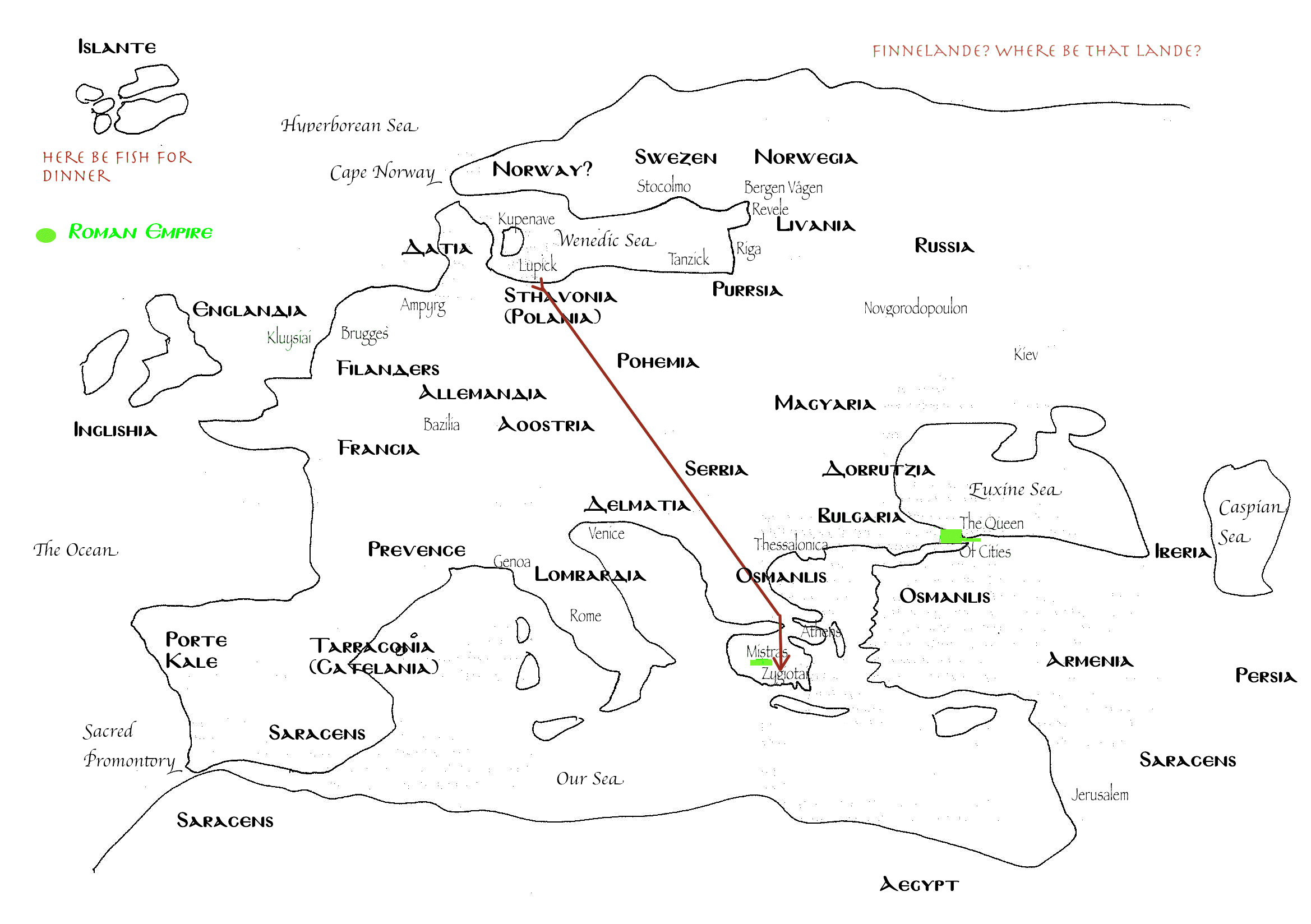
The next map, courtesy of my Mad Graphix Skillz, is not a rigorous reconstruction of Cananus' Europe at all; and I certainly wasn't checking with the more correct Nüssli. But it will serve to prove the point that Cananus wasn't talking about quite the same Baltic that Nüssli is:


Back to language stuff. The text has snippets of the vernacular: ἔφτασα (spelled in the ms. εὔτασα), for Ancient ἔφθασα "I arrived", ὑπάρχουν for ὑπάρχουσι "there exist", ἑξῆντα for ἑξήκοντα "sixty". Messy spelling, although that's pretty usual whenever there are snippets of the vernacular. Lundström argues that Lascaris Cananus must be the historian John Cananus, because the historian excused himself for his crap Greek. But everyone those days excused themselves for their crap Greek, so it proves little.

OK, revised translation, based on Blomqvist's edition, and revised table of place names.
I, arriving much land of Europe (sic), and I have "walked" around its whole coast, from the Hyperborean Ocean. Here there is a very large gulf, called in Classical Greek Wenedic; its perimeter is 4000 miles, and its diameter from the northernmost cape of the so-called Cape of Norway, down to its corner in the district of Prussia, is 2000 Italian miles, which have 1000 fathoms per mile; in our [measurement], with 750 fathoms in the mile, it is 2250 miles. And it is surrounded, from its east and west side, [by six districts?]

"Wenedic" is Ptolemy. 2000 Roman miles is 2960 km. 2250 Greek miles is 2993.6 km. "By six districts" is Lambros' emendation; Lundström also suggests "these districts", or even "three districts on either side".
And first of all, going from the east, and in its northernmost parts is the district of Norway, which also has a presiding city called Bergen Vågen. In that city engraved [currency] is not in circulation, neither gold nor silver nor copper nor iron. They exchange with merchandise, both buyers and sellers. Moreover in that city the day is a month long; from the 24th of the month of June until the 25th of July, the whole is daytime, and there is no night at all.

The German and Russian translators were thrown by ἀλλὰ ζοῦν "but they live", and assumed it was instead a participle, referring to living merchandise—"barter in livestock". But Lundström already knew this was an indicative, and Blomqvist emends it to ἀλλάζουν "they exchange".

This is where Norway gets to be East of Sweden and Estonia, and Lundström hopes that Cananus meant to write "West" instead.
After that district is the district of Sweden, which also has a presiding city Stockholm. In that city they mint engraved [currency] which is adulterated silver. These two districts are ruled by the king of Denmark.

Under the Kalmar Union.
After Sweden comes the district of Livonia. And this district has a presiding city which is called Riga, and the town of Revel. These [cities] are ruled by the archbishop, in both secular and spiritual [matters]. And the district is ruled by the Duke [of] the Grand Master of the white clothes and the black cross.

καὶ χώρα Ῥήβουλε "and the town of Revel" had been misread as καὶ ἑτέρα Ῥήβουλε "and another one [called] Revel".

The white clothes and black cross, as linked last time, are the uniform of the Teutonic Knights.
After that district and in the corner of the gulf is the district of Prussia. And it has a presiding city called Danzig.

After that is the district of Slavonia, which has a presiding city called Lübeck. From this district come the Zygiotai in the Peloponnese, since there are many villages there, which speak the language of the Zygiotai.

The manuscript has <Sthabunía>, and Lundström momentarily wonders whether this is meant to be <Esthonia>; but Livonia already includes Estonia.
After that district is the district of Denmark, which has a city called Copenhagen. That [city] is also the kingdom [seat] of the king of Denmark.

These are the six districts around the gulf.

I also arrived at the island of the Fish-Eaters, which is commonly called Iceland; but according to the wise Ptolemy, it seems to me, it is Thule. There I found the a day six months long, from the beginning of spring until the turn of autumn. For I passed from England1 to that island, and the sailing was 1000 miles; and I [erred] there for 24 days, and I saw men strong and sturdy; and their food was fish, and their bread was fish, and their drink was water.

ἐπλημέλησα "err" is a scribal error, and Blomqvist is reluctant to emended it as ἐπλήρωσα "I fulfilled, I spent".
Then I turned back to England2.

And the mileage from the aforementioned city of Bergen Vågen to Sluis in south Flanders in a straight line is 3500 miles; and from Sluis to the Sacred Promontory in Portugal is 2164 miles. Namely, all together 5664 miles, without setting into harbours.

Both Lundström and Blomqvist think that 2064 in the manuscript is an error for 2164, because the text has ἑ- ξιντα, which could involve an eye skipping over ἑκατὸν ἑξῆντα.

And the revised place names:
EnglishManuscriptBlomqvistModernNotes
EuropeEurō´pēEurō´pē
BalticUenedikôsUenedikósPtolemy: Venedic
NorwayNorbegías, NorbégiasNorbēgíaBoth genitives are consistent with a nominative <Norbégia> whose accentuation is Italian
PrussiaPursíaPrōsíaModern form *may* be analogy from Rōsía for Russia
BergenMpérgenMpérngenModern Greek has gone full /ˈ(m)ber(n)ɡen/ rather than just /ˈmberɣen/
VågenBágenModern Greek has gone full /ˈ(m)ber(n)ɡen/ rather than just /ˈmberɣen/
SwedenSuē´tziaSuēdíaLatin Suecia, Italian Svezia; again, recessive accentuation consistent with Italian
StockholmStokólmōStokchólmēItalian Stocolma. Modern form preserves /k.h/, and makes it declinable.
DenmarkDateíaDaníaVasiljev speculates this is via Slavic, and may indicate Cananus went to Denmark via Novgorod. But Datia shows up elsewhere, e.g. a 1459 Italian map.
LivoniaLibaníaLibanía Inphlántē in Chalcocondyles, via Polish Inflanty. Livonia included modern Latvia and Estonia. Lundström had emended it to <Libonía>.
RigaRē´gaRíga
RevelRēbúlēNow Tallinn; Revel was the name of the city since the Danish conquest of 1219. Latvian Rehwele, and Lundström thinks Kananos heard /w/ as /v/.
DanzigTántzēkNtántsichAt the time, German -ig was not yet [iç].
SlavoniaSthabuníaSthlabunía?(Cf. Slobenía "Slovenia")Assuming Sthabunía is an error for Sthlabunía, this uses the characteristically Byzantine epenthesis of /θ/ in /s.l/ (with which I derailed a comment thread at the Magnificent Nikos Sarantakos' blog)
LübeckLúpēkLúmpekMiddle German Lubek, Lubeke, Mediaeval Latin Lupeca, Lubicca. Again Modern Greek embraces /(m)b/ in transliteration, Byzantine doesn't.
CopenhagenKupanábēKopenchágēDanish København: Lundström quotes the original Köben(de)haffn, and attributes <Kupanábē> to a Nordic Köbanhavn, with <-e(n)> for vocalic /n/. Modern Greek and English from Low German (those Hansa people).
IcelandIslántēIslandíaModern Greek here has affixed the suffix -ia; ditto Greenland Groilandía, Holland Ollandía. However more recent -lands have been left as -landē (now with a delta, natch): Tailándē, Kuinslándē.
England1ĒnglēníaAnglíaThe English are Inglínoi in Chalcocondyles, but <ē> and <i> are both /i/. Googling hints that Inglini was in use in Latin as well.
England2EnglitéraAnglíaItalian Inghilterra
SluisKlúzaiSlóisKlózioi in Chalcocondyles, French l'Ecluse from Latin exclusa "gateway"
FlandersPhilantríaPhlamandía, PhlándraThe first Modern form is modelled on French Flamand "Fleming", the second of French Flandre "Flanders". Phlamandia seems to be locally modelled on the ethnic Phlamandos, and the only parallel I can find googling is Polish Flamandia. Lundström had emended < Philantría> to <Philantría> <Phlantría>, which is naughty.
PortugalPórte GálePortogalía<Portugallía> in Chalcocondyles.

...Read more

2009-09-07

Islántē: Island Of The Fish-Eaters

[EDIT: This post has been updated]

The quiz I set last post gave me an excuse to Google Σαμῶται, and in the process to find that Lascaris Cananus is online—after a fashion. So this post is about him.

Lascaris Cananus wrote a page about his visit to Lithuania, Sweden, Denmark, and Iceland in the 15th century; the date seems to be 1438–1439. I knew about this text for a very long time, because it features in histories of the Greek language. It features in histories of the Greek language because it includes a single throwaway line, indicating that Slavonic was still spoken in the Southern Peloponnese in the 15th century, by the Zygiotai (who lived on the Zygos, the "yoke", of Mt Taygetus).

Beyond that, Cananus answers the question I posed my friend Tania last week, home from Iceland: "what is the Icelandic native cuisine?" Most people call the place Islantē, Cananus reports; to him, it's The Island Of The Fish-Eaters.

Lascaris Cananus may or may not be the same as John Cananus, who wrote an account of the Ottoman Siege of Constantinople of 1422. The Swedish Wikipedia article is about Lascaris but mentions John as possibly the same person; the English Wikipedia article was about John, and as of today mentions Lascaris as possibly the same person. Wikipedia links the two articles, and I won't prevent it. Still, the author of this page is likely a merchant and not a scholar.

(The Catalan Wikipedia article is about John, and doesn't mention Lascaris. The Greek Wikipedia doesn't have anything on any Cananus, and I wish I was surprised :-( )

The text has shown up in scholarly attention as follows:

Jakob's monograph is about Arab travellers in Germany, which sounds even more interesting than Byzantines in Iceland; but this is still a blog on Greek linguistics.

I have ordered the Swedish monograph (2 pp of Greek, 44 pp of Swedish); but to my delight, both the Russian and the German article (translated into Russian) have been put online by Russians, which inspires much gratitude. I'm finding a lot of Byzantine material gets put online by my fellow inheritors of Byzantine heritage.

And because both the Russian and the German articles contain translations of Cananus, I'm going to triangulate and put one up into English. I admit it's unscrupulous to entertain the translation chain Greek > German > Russian > Babelfish English; but if I wanted to be scrupulous, I wouldn't be blogging.

I'll note that Jakob thinks 1439 is a bit too late for Slavic to be spoken around Lübeck, and thinks the reference is to a Sorbian factoria (trading colony) in Lübeck, under the Hansa, just as Danzig was a Prussian trading colony. (And Prussian back then did not mean German.) I don't know where Sorbian was spoken in 1439 (it's pretty inland now), but Cananus clearly had the impression there was contiguous Slavic speaking territory around Lübeck; and if it wasn't Lübeck, it was somewhere close enough to allow the confusion. Of course, we have no way of knowing whether Cananus actually set foot in Lübeck.

Jakob also wonders whether Cananus is talking about the Roma, who had recently arrived in both the Peloponnese and Lübeck; but we have evidence of the presence of Slavs in the Peloponnese from other sources. So the conflation with the Roma would be unmotivated. (I'm amused that Babelfish translates Циганы as "Roma" and not "Gypsies", but fair enough, I suppose.)

So, here's the Babelfish triangulation:
I have visited many countries in Europe, traveled all of its coast in the Hyperborean Sea. There is a large bay, called in Greek Uenedikos ("Venedic", the Baltic Sea). Its circumference is 4000 miles and its diameter from the northern tip of the so-called Cape of Norway (Νορβεγία) to the farthest corner of the land of Prussia (Πουρσία) is 2000 Italian miles, where a mile is 1000 yards [сажень, клафтер]. In our reckoning, a mile is 750 yards, so it is 2250 miles. From east and west, it covers [...]

First of all, starting from the east, the most northern part of the country around the Gulf is Norway, which has a capital that is called Bergen Vågen (Μπέργεν Βάγεν). [Vågen is a bay in the centre of Bergen.] In this city there are no hammered coins in circulation, either gold, silver, copper, or iron: buyers and seller exchange livestock. Furthermore, in this city day lasts a month, from June 24 until July 25 is continuous daytime, and there is no night at all.

After this country is the country of Sweden (Σουητζία), which has the capital of Stockholm (Στοκολμώ). In this city silver coins are minted. Both countries are governed by the King of Denmark (Δατία).

After Sweden comes the country of Livonia (Λιβονία). This country has a major city called Riga (Ρήγα) and another called Revel (Ρηβούλη, now Tallinn). These (cities) are controlled by bishops in both secular and ecclesiastical matters. The country is controlled by the Prince Grand Master of the white robes and black cross.

After this country in the inner corner of the bay is the country of Prussia. It has a capital called Danzig (Τάντζηκ).

After this is the country of Slavonia (Σθλαβουνία), which has a capital called Lubeck (Λούπηκ). From this country the Zygiotai (Ζυγιῶται) in the Peloponnese have originated, because there is a large number of small towns [in Slavonia], where they speak the dialect of the Zygiotai.

Next to that country is the country of Denmark, which has a city called Copenhagen (Κουπανάβη). It serves as the residence of the King of Denmark.

These are the six countries that lie around the bay.

I have also been to the islands of the Fish-Eaters (Ἰχθυοφάγοι), which are usually called Iceland (Ἰσλάντη), but for the wise Ptolemy, I believe, this was Thule. There I found the day lasted six months from the beginning of spring until the autumn solstice. I went to the islands from England (Ἠγγληνία). It is a voyage of 1000 miles, and I was there for 24 days. And I saw a strong and sturdy people; their food was fish, and their bread was fish, and their drink was water. Then I returned back to England (Ἐγγλιτέρα).

The distance in miles in a straight line from the aforementioned city of Bergen-Vågen to Sluis (Κλούτζη), in the south of Flanders, is 3500 miles, and from the Sluis to the Holy Cape [Promontorium Sacrum, Cape St. Vincent] in Portugal is 2064 [2164?] Miles, which is a total of 5664 miles [yes, I know that doesn't add up], if you don't count going into the harbours.


And since I was talking about different transliterations between Byzantine and Modern Greek, here is a comparison:
EnglishCananusModernNotes
NorwayNorbegíaNorbēgíaShort e, long e, what's the difference? (Well, /norveˈɣia/ vs. /norviˈɣia/ for starters...)
PrussiaPursíaPrōsíaModern form *may* be analogy from Rōsía for Russia
BergenMpérgenMpérngenModern Greek has gone full /ˈ(m)ber(n)ɡen/ rather than just /ˈmberɣen/
SwedenSuētzíaSuēdíaLatin Suecia
StockholmStokolmōStokchólmēModern form preserves /k.h/, and makes it declinable
DenmarkDatíaDaníaVasiljev speculates this is via Slavic, and may indicate Cananus went to Denmark via Novgorod. But Datia shows up elsewhere, e.g. a 1459 Italian map.
LivoniaLiboníaLibonía Inphlántē in Chalcocondyles, via Polish Inflanty. Livonia included modern Latvia and Estonia
RigaRē´gaRíga
RevelRēbúlēNow Tallinn; Revel was the name of the city since the Danish conquest of 1219
DanzigTántzēkNtántsichAt the time, German -ig was not yet [iç].
SlavoniaSthlabunía(Cf. Slobenía "Slovenia")Uses the characteristically Byzantine epenthesis of /θ/ (with which I derailed a comment thread at the Magnificent Nikos Sarantakos' blog)
LübeckLúpēkLúmpekAgain Modern Greek embraces /(m)b/ in transliteration, Byzantine doesn't.
CopenhagenKupanábēKopenchágēDanish København. Modern Greek and English from Low German (those Hansa people).
IcelandIslántēIslandíaModern Greek here has affixed the suffix -ia; ditto Greenland Groilandía, Holland Ollandía. However more recent -lands have been left as -landē (now with a delta, natch): Tailándē, Kuinslándē.
EnglandĒnglēníaAnglíaThe English are Inglínoi in Chalcocondyles, but <ē> and <i> are both /i/. Googling hints that Inglini was in use in Latin as well.
EnglandEnglitéraAnglíaItalian Inghilterra
SluisKlútzēSlóisKlúzioi in Chalcocondyles, French l'Ecluse from Latin exclusa "gateway"
...Read more

2009-09-03

What's Londínon in the language of the Inglínes?

I've been working on lemmatising the TLG for, oh, over six years. And lemmatising the TLG includes lemmatising its proper names. The TLG is, in quantity, a mostly Byzantine corpus, even though the point of the TLG was ancient literature: the Byzantine corpus is what survived most. And in the absence of a Byzantine gazetteer that I knew of, I ended up entering unrecognised place names by hand, prioritising the most frequent ones first. I haven't exhausted them and doubt I ever will, but I have a threshold of frequency above which all place names are accounted for.

And because I did not already have a gazetteer digitised, this meant I noticed what places Byzantines talked about more, and what they talked about less. Which brought to life for me something I could have told you already, but was startling to see anyway. The outside world for Byzantines—and I start counting after Justinian—was the Caliphate, Bulgaria, occasionally Italy, Russia once or twice. Western Europe? They didn't even notice it was there.

Which is startling to a Modern Greek, because we've successfully reoriented ourselves westwards. Nowadays I'm sure more Grecophones have heard of Charlemagne than Harun al-Rashid. At the time, I'm sure Grecophones had it the the other way round. In fact, as I've noted elsewhere, Theophanes the Confessor only knew of Charlemagne as Karolos, Pepin's son—although by the time he was writing his chronicle, Charlemagne was already Holy Roman Emperor.

(That's Grecophones, btw, not Greeks. There's a reason John Tzetzes had a funny surname...)

Byzantine sources do become aware of the West outside Italy, but only at the very end of the Empire's allotted time, when the Caliphate has become their Ottoman suzerain, and the West is where they're soliciting a crusade from. That's when Byzantines notice that there is such a thing as western theology, and translate Augustin (Prochorus Cydones) and Boethius (George Pachymeres, Manuel Holobolus, Maximus Planudes, Prochorus Cydones).

Even at the end, Byzantine historians are exasperatingly antiquarian, use Roman terms whenever they can, and don't seem that tuned in to the subtleties of the distinctions between the Beef-Eaters. The Catalans, who ran chunks of Greece for a couple of generations? Tarraconians. The Hundred Years' War? A war between the Celts and the Gauls. Straight out of Julius Caesar. And yes, *I* know the Gauls were Celts, and the English were no longer Brythonic. I'm not convinced the historian in question did.

Just like the Serbs were written down as Triballians, and the Bulgarians as Mysians, and the Turks, occasionally, as Persians. Just like the Mongols were written down as Tocharians—reviving some obscure Central Asian tribe name which at least had a Classical pedigree. (Oh, the people we now call Tocharians? Probably weren't the same obscure Central Asian tribe. We did the same classicising revival.)

Just like John Cananus, around 1400, went on a trip to Lübeck, which at the time still spoke Sorbian (or whatever else it was called), and proclaimed "this must be where our Ezerites have come from"—because in 1400 a Slavonic language was still spoken in the Southern Peloponnese too. And John Cananus completely missed half a continent's worth of Slavonic spoken between northern Germany and southern Greece.

So it's startling when a bona fide contemporary Western place name does turn up in this corpus. Unsurprisingly, they're more cities than peoples, since cities were harder to do a Roman-era vagueout on. In the former bits of the Byzantine empire that were already being run by the West, it was much easier to notice the West; and the vernacular Greek chronicles of the 14th and 15th century use the Western terms more forthrightly.

Which brings up another surprise to Modern Greek speakers. Learnèd Modern Greek used to Hellenise Western place names, and they'd do so by pretending the transliterations were still pronounced as they would have been in antiquity. Or rather, given the denial about phonetic change among Greeks, they used the spelling correspondences between Latin and Classical Greek, and put their hands on their ears.

So Dublin is written Δουβλίνο(ν), which is pronounced /ðuvˈlino/ but written in historical orthography as <Dublinon>. Nuremberg is written Νυρεμβέργη, which is pronounced /niremˈverɣi/ but written <Nyrembergē>. Brussels is written Βρυξέλλες, pronounced /vriˈkseles/ but written <Bryxelles>. Since <y> was IPA /y/ and French u, that is an exact transliteration of French Bruxelles.

(The < > are used in linguistics to notate graphemes, units of writing, just as / / are used to notate phonemes, units of sound. If the former is less familiar to you than the latter, it's because the bias of linguistics over the past century has been to pretend orthography isn't worth studying.)

The surprise in Byzantine names is that both the learnèd and the vernacular sources transliterate names differently from how they're now done. On the one hand, the vernacular sources don't bother rerouting names via Ancient Greek, and write the names as they heard them. Austria is now Αυστρία /afˈstria/ <Austria>; but it's first recorded in vernacular garb (the same garb it had in the 18th century vernacular), as Ἀουστρία /auˈstria/. Bavaria is now Βαυαρία /vavaˈria/ <Bauaria>, but it is first attested in, of all places, the War of Troy, as Βαουβέρη /vauˈveri/. (Admittedly, that's not that close to /bajern/, and was probably just a written form to the translator.) Hungary was called Ματζαρία /madzaˈria/ "Magyary"; Budapest is now Βουδαπέστη /vuðaˈpesti/ <Budapestē>, but Buda back then was Μπούντουνη, Πιτούνιν, Μπούδα: /ˈmbunduni/, /piˈtunin/, /ˈmpuða/. The Germans were Αλαμάνοι /alaˈmani/, when they weren't Νέμτσοι and Νεμίτζοι /ˈnemtsi, neˈmitsi/.

Some of those vernacular names died later than others. We now call the French Gauls (Γάλλοι), just like the Byzantines did; but people still recognise the old name Φραντσέζοι /franˈtsezi/. The learnèd/colloquial doublet Άγγλοι/Εγγλέζοι /ˈanɡli, enˈɡlezi/ survives for the English, though the older /inˈɡlini/ does not, and nor do the eleven spelling variants of /enɡliˈtera/ for "England". (You've worked out by now what the title of this post means, yes?) Tunis is now Τύνιδα /ˈtiniða/, Demotic for Τύνις, -ιδος <Tynis>. But, from either a song lyric or the angry retort to "oh?", Greeks still know about Τούνεζη και Μπαρμπαριά /ˈtunezi ke barbarˈja/, "Tunis and the Barbary coast".

You won't be wrong, btw, in gathering that the Greek vernacular knowledge of Western Europe was filtered through Italian.

(And the angry retort? The Greek for "oh? is that right?" is "/ba/?" The echoic retort is Μπα-ρμπαριά και Τούνεζη!)

On the learnèd side, one surprise is that even though the 19th century clerks and the 14th century clerks had mostly the same approach to Hellenising place names, they didn't always compare notes. That's probably the 19th century guys' fault, what with the ESP deficit in late Byzantium.

So Flanders now is Φλαμανδία <Flamandia>, via French; in Anna Comnena, it's Φλάντρα <Flantra>. Normans now are Νορμανδοί <Normandoi>; to Anna they were Νορμάνοι <Normanoi>. Provence is now Προβηγκία /provinˈɡia/ <Provinkia>, but Atticist as Anna was, she was happy enough to leave it as Πρεβέντζα /preˈvendza/. So the 19th century hellenisations we now know were not handed down to us like family heirlooms: they look old enough to have been, but they're not.

The other surprise is what learnèd transliterations do with voiced stops. By the time we're talking, Greek didn't have voiced stops: it had voiced fricatives which used to be voiced stops; it had voiceless stops; and it had prenasalised voiced stops. So, δ τ ντ /ð t nd/ <d t nt>. What then did you do when you had to transliterate a name with a /d/ in it?

The "La-La-La We Speak Classical Greek" school of thought was, if a delta was good enough for Decimus and Diocletian (Δέκιμος, Διοκλητιανός), then it was good enough for modern names with /d/ in them. That's why Charles Darwin is still Κάρολος Δαρβίνος /ˈkarolos ðarˈvinos/ <Karolos Darbinos>, and not Τσαρλς Ντάργουιν /tsarls ˈndarɣuin/. The vernacular OTOH figured that /nd/ was as close as you'd get to /d/—and dialects were already starting to simplify /nd/ to [d] anyway. So the Danube, which was at first Δάνουβις /dánubis/ (and the Istros before that), turns up in the vernacular as Ντούναβης /ˈ(n)dunavis/, after its South Slavic name Дунав. (The contemporary form is in between: Δούναβης /ˈðunavis/ <Dunabēs>.)

There was a third path though. You could hesitate between /ð/ and /nd/, and go with /t/ instead, the voiceless stop. We see this already in Anna Comnena with her rendering of Dagobert: Τακουπέρτος, /takuˈpertos/—although Bohemund to her was still Βαϊμοῦντος, /vaiˈmundos/ <Baimuntos>. You also see it with Bohemians. When the Greeks first noticed Bohemians. it was because they noticed Jan Hus, as part of their negotiations with the Catholics; and the Bohemians got to be Βοέμιοι /voˈemii/ <Boemii>, with the classicising beta. But they also got to me Ποέμιοι and Πωέμιοι /poˈemii/, with a /p/ close enough to a /b/.
A few Greeks among you are reminded of Cypriot at this point. Greece transliterates video as βίντεο /ˈvindeo/ <binteo>; Cyprus uniformly transliterates as βίτεο /ˈviteo/ <biteo>, just like Takupertos. Cyprus has its own rationale for that: its choices are not /ð (n)d t/, but δ ντ τ ττ /ð nd t tʰ/. If Turkish tel "wire", Standard Greek τέλι, is ττέλιν /tʰelin/ in Cypriot, that means ττ is for foreign /t/, and τ without an /n/ in front of it is for foreign /d/. Greece Greeks think that amusing, because Greece Greeks have no conception of a pluricentric language.

The Modern clerks did not compare notes with the Byzantine theologians on Bohemians, and the mainstream word is now Βοημοί /voiˈmi/ <Boēmoi>, with a long e. The bouzouki players noticed Bohemians too—via La Bohème; and Μποέμισσα /boˈemisa/, "Bohemian woman, tramp", is a recurrent and quite vernacular figure in rebetiko songs.

One of the first people to notice Bohemians was Laonicus Chalcocondyles, one of the historians of the Fall of Constantinople. In fact, Chalcocondyles' text is an explosion of hitherto unnoticed Westerners. It's like, just as the door closes on the Roman Empire, a window opens to the West. Poland's in there, and Portugal too—though as Polania and Portugallia, not the modern Polonia and Portogalia. Avignon's there, and so is Austria without an /f/.

But Chalcocondyles is still a hardcore antiquarian: it does indeed take "a pen of brass" (χαλκοῦν κονδύλιον) to flip around your given name like that, and transmogrify "Nicholas". His Englishmen are still Angli, and his Catalans are still Tarraconians, and his Danube is still the Istros. And his antiquarianism is enough to make hard work of knowing where he's talking about.

And so I conclude with a little quiz for those of my readers patient enough to have persevered thus far. These are some European place names and peoples in Chalcocondyles. (And I'm counting the Caucasus as European.) Your challenge is to decipher them. It is possible to cheat (there's a reason I know the answers); I invite you not to.

Hopefully you'll nut these out entertainingly in the comments, and I'll come back with the right answers in a week. Some of these are easy; some... are impossible. There are places in here I'd never heard of. Good luck, you can curse me in a week's time. I never said I was not a sadist, did I...

(Nikos Sarantakos, I owe you big time for that puzzle you posed me on the Elbe, so I'm expecting a good showing from you! >:-)

(Language Hat, sorry to have just destroyed your evening... ;-) )
Regions
  • 1. Ἰνφλάντη Inphlántē
  • 2. Καχέτιον Kachétion
  • 3. Κεντία Kentía
  • 4. Μάρκη Márkē
  • 5. Δοβροτίκης Dobrotíkēs

Cities
  • 6. Βριξία or Πρηξία Brixía/Prēxía
  • 7. Γαΐτια Gaï´tia
  • 8. Γαντύνη Gantýnē
  • 9. Βρούγιοι Broúgioi
  • 10. Κλιτίη Klitíē
  • 11. Κλόζιοι Klózioi
  • 12. Νορόβεργον Noróbergon
  • 13. Ἀμπύργον Ampýrgon
  • 14. Σιβίνιον Sibínion
  • 15. Σιβίληνα Sibílēna
  • 16. Ταρβίζιον Tarbízion
  • 17. Καλέση Kalésē
  • 18. Βαζιλείη Bazileíē
  • 19. Βωκερίνη Bōkerínē
  • 20. Κιόζη Kiózē
  • 21. Νίτια Nítia

Peoples
  • 22. Σαμῶται Samōtai
  • 23. Σαχαταῖοι Sachataîoi
  • 24. Τζαρκάσοι Tzarkásoi
  • 25. Κέχιοι Kéchioi
...Read more

2009-08-27

War of Troy

For far, far too long, scholars have treated Early Modern Greek literature as linguistic quarry, and have neglected these texts as literature in their own terms. Over the past couple of decade, this injustice has finally started to be redressed, as the Romances in particular have gained much deserved attention.

This post, on the other hand, continues in the bad old tradition.

As the TLG expands its coverage into Early Modern Greek, I have gone through the word recognition of the War of Troy. The War of Troy is an interesting text, and I am going to say some very superficial things about it.

The War is a retelling of the events of the Iliad. It's not a first hand retelling. Around the end of the Roman empire, two people calling themselves Dictys the Cretan and Dares the Phrygian—and eyewitnesses to what went down in Ilium—wrote popular Latin retellings of the story. The Middle Ages being a gullible time, Dictys' and Dares' narrative ended up taken more seriously than Homer's. After all, Dictys was there!

A few centuries later, Benoît de Sainte-Maure based his Roman de Troie on Dictys' and Dares' Latin. Some time after that, an anonymous Greek produced a Greek translation. (Outside Crete, anyone writing in the vernacular was anonymous: it wasn't the kind of writing you took credit for.)

So we have a three generations down retelling of the Homeric original. Greeked by a writer who knows the names of Achilles and Helen in Greek, but not much else: there's no evidence the translator knew any Homer. (And why would he need to? After all, Dictys was there!)

So you can imagine what's happened to the names in this. That was a fun couple of nights to work through. The translator would take a look at the Old French, breath in, and guess. From what I can see, Benoît had done the same. Telemachus (Τηλέμαχος "Fights-Far-Away") becomes Θελέμαχος "Wanna-Fight". Assyria becomes Ζύρη. Boeotia Βοιωτία becomes Βοέκη (via Boëce). The King of the Scythians Rex Scytharum became Citare and thence Κιτάριος. A king from Syme, ex Syme, became Essimieïs and thence king of Ἐξιμιόνη. Somehow, Zeleia Ζέλεια ended up as Σιτζήλια, and Sicily Σικελία as Ζήλικος. We even have a Ἱουπιτής and a Νέπτιπος in the cast. That's Jupiter and Neptune to you. And the only way I can explain Iphinoös Ἰφίνοος becoming Ἰσίδιος is via f looking like ſ (long s). (Did they have long s in 1400?)

All very fish in a barrel, that, so we'll move on. The War of Troy was first published very very late. In fact, 1996. Each romance has its own vocabulary: the romances liked coining compounds, the War in particular has a lot of partly digested Old French, and there are some words that look to be one-offs anyway. But there are three reasons why we're going to have serious gaps in documentation of the War's vocabulary for a long time.
  • Most Early Modern texts had some sort of edition, however crappy, available by the time Kriaras started writing his dictionary. The War didn't. So the volumes of Kriaras written before 1996 won't know anything about its vocabulary.
  • The volumes of Kriaras up to 1997 each had addenda about new words that had turned up since the last volume. A horrid chore if you're looking up a word, but editing Early Modern Greek is still a boom industry. (Or it was 10 years ago, when I was able to follow it.) So that kind of update does need to happen. After its decade hiatus, the new volumes don't have addenda. So unless there's a change of policy (or they become a real electronic dictionary, with dynamic update), Kriaras is not going to cover the War at all.
  • That's *real* electronic dictionary. The online abridgement was supposed to keep updating with each volume of the post-hiatus full dictionary. Nothing's happened in the past three years.
  • The editors of the War said they would publish a Volume II with a glossary. (Mercifully, they did put in a few pages of the more common undocumented words in Vol. I.) It's been 13 years, and Google tells me naught; I have no particular reason to hold my breath that I will see a Vol. II.

It's a shame, because the glossary they do include has some words that I'm scratching my head about.
  • I'm convinced I've seen καιρογεύω "to hire" somewhere before, but I have no idea where. Neither does Kriaras or Trapp.
  • A γορζέρα is a visor on a helmet, translating French ventaille. (Yes, of course the War of Troy has visors and jousting and mediaeval stuff.) But ventaille is not [ɡorzera], and there's no way that's a Greek word. Where did it come from?
  • καλανίζω means "to spatter". Where did *that* come from?
  • Ditto τόρτσα [tortsa] for chandelier, and χωρίγιν [xoriɣin] for "cement".

I suspect some of this is Italian or Venetian, but some of it clearly isn't.

There's a reason the War took so long to publish. It's huge by the standards of the time: 14000 verses. It was quite popular (six surviving manuscripts), so there's a lot of manuscript collation to do. We have the French original, which you also have to take into account when doing the collation. What that leaves you is a lot more donkey work than usual for editing a text: normally you'd be lucky to have a couple of manuscript witnesses.

It also means the temptation there is emend the text, to match the French original more closely. The degree of emendation in the War is more than most scholars these days are comfortable with; and because the emendation did not prioritise linguistic plausibility, you have to look in the margin (the source readings) if you're going to do any linguistics with the text. There are anachronisms in there.

Emendation in mediaeval texts is inevitable, just as it is inevitable in Classical texts: texts got miscopied, mistransmitted, misconstrued. But vernacular texts don't work like Classical texts in transmission: the scribes feel a lot freer to tinker with the text, because ten centuries of Ancient Authority aren't going to gainsay them. And the results of a scribe tinkering with a vernacular text are not as noticeable as with a Classical text—so you have less of a gut instinct to go with, for which of two variants is the original.

Gut instinct is a risky thing to rely on anyway, and Early Modern Greek texts have suffered a lot from Modern Greek scholars coming along, and assuming they know the language and metre and poetics of the texts better than the scribes did. The scribes were often enough blockheads, that's true. That doesn't mean modern editors aren't fallible.

The world owes Stylianos Alexiou, for instance, gratitude for making the Escorial Digenes legible, and reviving Cretan Renaissance theatre. The world does not owe Stylianos Alexiou gratitude for:
  • Assuming 14th century iambic heptameter was the same as 20th century iambic heptameter, and emending it when it wasn't
  • Assuming the 16th century dialect of Rethymnon was the same as the 20th century dialect of Rethymnon, and emending it when it wasn't

It's not that they are not usually the same; but they are decidedly not always the same, and you'd better have an explicit argument for when you do tamper with the text.

And I'm sorry, but in the same vein, if you're editing a 14th century text like the War of Troy, and you're looking to emend a verse with a single-syllable future particle, because the French original is in the future tense—you do NOT use a particle that first appeared in Greek in 1700! What on earth use is that? Would you put "gonna" into your Chaucer? "Kthxbye" into your Dickens?

"tl;dr", that you can put into Dickens...

The particle in question is θα, which in 1400 was only starting to be emerge as the uncontracted θέλω να. The monosyllabic particle they were actually looking for was να, the subjunctive marker: the future was "I may go" in 1200 before it started becoming "I will go" in 1400, and by 1700 "I'll go"—if I can use English analogy here.

"θα exists in this text only by emendation (1816, 8796, 8972)" p. lxxvii—it shouldn't be there at all. Verse 1816:

Ἐτοῦτοι ὁποῦ εἰς τὰ κάτεργα θὰ εῖναι διωρθωμένοι
"Those who in the galleys shall be set right"
1816 θὰ Pap[athompoulos], cf. 4669 E cil qui remandront as nes : ἂς ABVX.

The ἂς reading is grammatically awkward, and somewhat odd ("those who in the galleys may they be set right"); but it's in all the manuscripts, and is not outright wrong. If you want to claim that the translator must have rendered the future remandront with a future, then for pity's sake use the historically plausible future: Ἐτοῦτοι ὁποῦ εἰς τὰ κάτεργα νὰ εῖναι διωρθωμένοι

Let that be a lesson to... well, to someone.
...Read more

2009-05-11

Placenames of Kievan Rus'

A culture confident in itself (or arrogant, same thing) will assimilate foreign place names and personal names, bending them to its language. Thus did Kshayarsha become Xerxes, and Shoshenq, Sesonchosis. Thus did Svyatoslav become Sphentísthlavos, and Dagobert Takoúpertos, and Saint-Gilles Isangéles. Thus did Hujr become Ógaros, and Ma'di Karib Badichárimos, and Kormisosh Kormésios. Thus, in late reassertion of confidence, did the clerks call Newton Néfton, and Darwin Dharvínos and Descartes (via Latin) Kartésios (and France Ghallía instead of Frántza, and England Anglía instead of Ingiltéra); while Makriyannis, no less confident on behalf of the people, call Armansberg Armaspéris, de Rigny Dernýs, and Washington Vásikhton.

Greece now is not that place; in fact, rather more often than not, they won't even transliterate foreign personal names, so that there is now a whole lot of Latin script in any extended stretch of discourse. That projects several things; self-confidence (or arrogance, same thing) is not one of them. The advantage of transliteration though, is at least you're not left scratching your head, wondering what the hell is being talked about. If you're not forewarned, you need a lot of staring to work out who is meant by Γοίθιος.

If you're working on earlier stages of the languages, there are even more traps for the unwary. Theophanes the Confessor, writing in the early 9th century with slightly out of date information, writes of Pippin the Short's sons: p. 403 de Boor, οὗτος ὁ Πίπινος δύο υἱοὺς ἔσχεν, Κάρουλον καὶ Καρουλόμαγνον, τὸν ἀδελφὸν αὐτοῦ "This Pippin had two sons, Károlos and Karoulómagnos his brother". Which one's Charlemagne? Not Karoulómagnos: noone was calling Charles Great when he was running around in diapers. Charlemagne is Károlos, Charles (or, properly speaking, Karl): Karoulomagnos is his brother Carloman. Why on earth Carloman got distorted to Carlomagn, by the last people on earth prepared to call his brother Great, is a mystery to me.

Which leads me to my fun and games decoding Russian placenames last night. I was hoovering up by inspection the proper names of the registry of documents of the Patriarchate of Constantinople, an edition of various legal texts held by the patriarchate. Lots of these documents involve property and jurisdiction issues close to home; but a few documents involve setting up shop for the Orthodox Church in Russia in the 14th century.

Russia in the 14th century was a very different place than what it is now. For one, it wasn't quite Russia as we know it: it was the Kievan Rus', run out of Kiev: Muscovy is not even mentioned in the documents, and was only starting to be noticed by its neighbours. There was no distinction made back then between Russia, the Ukraine, and Byelorussia. The important cities of the time are not all important cities in our time; and the map was being turned upside down constantly with the Mongol invasions. So a list of bishoprics in a 14th century document is not going to jump out of the page as familiar to an uninformed 21st century reader. Especially when the names have been through the wringer of Greek phonology.

What complicates things even further is that many of the old bishoprics are in the borderlands of modern Poland and the former Soviet Union, regions with a complicated history. The history of the towns once covered by the Grand Duchy of Lithuania has been written in Lithuanian, and Polish, and German, and Russian, and Ukrainian, and Byelorussian, and Yiddish. It was in one of those cities that a Litvak child in the 1870s dreamed of an international language to reconcile the dissonances around him. And those cities have changed names many a time—including 1945, and 1990. As if it wasn't bad enough that the words are Grecified Russian to start with, their current names are Byelorussian or Polish that look different again.

I think I've worked out the lot, but some of them took some chasing, a lot of blank staring at the Wikipedia map of Kievan Rus', and some inventive Googling. So Peremísthlin, by inspection, is: Peremyshl (ru uk)—Przemyśl (pl)—Prömsel (de)—Pshemishl (yi). And Mpriániskon is (by a lot more searching, because it wasn't on the Kievan Rus' map) Bryansk.

The one I almost didn't get occurs in the following two passages:
259.54 (July 1361): περὶ μέντοι τοῦ ἱερωτάτου μητροπολίτου κῦρ Ῥωμανοῦ ὡς χειροτονηθέντα καὶ αὐτὸν Λιτβῶν διωρίσατο ὁ κράτιστος καὶ ἅγιός μου αὐτοκράτωρ συγκαταβάσεως λόγῳ καὶ ἅμα διὰ τὴν ἀνενοχλησίαν καὶ εἰρήνην τοῦ ἐκεῖσε τόπου ἔχειν σὺν ταῖς οὔσαις τῇ τῶν Λιτβῶν ἐπαρχίᾳ δυσὶν ἐπισκοπαῖς τὸ Πωλότζικον καὶ τὸ Τούροβον μετὰ καὶ τοῦ Νοβογραδοπουλίου, τοῦ καθίσματος τοῦ μητροπολίτου, καὶ τὰς τῆς Μικρᾶς Ῥωσίας ἐπισκοπάς

Concerning the most holy metrpolitan Lord Romanus, being ordained as bishop of the Lithuanians, my mighty and saintly emperor has appointed him by assent of word, for the peace and unperturbedness of that region, to hold as well as the two bishoprics in the district of the Lithuanians, Polotzikon and Tourovon as well as Novogradopoulion, the seat of the metropolitan, and the bishoprics of Little Russia.

262.9 (July 1361): Οἶδας, ὅπως συνέβησαν τὰ μεταξὺ τῆς σῆς ἱερότητος καὶ τοῦ ἱερωτάτου μητροπολίτου Κυέβου καὶ πάσης Ῥωσίας, κῦρ Ἀλεξίου, ἀγαπητοῦ κατὰ Κύριον ἀδελφοῦ καὶ συλλειτουργοῦ ἡμῶν, καὶ ὅπως διεκρίθη ψήφῳ βασιλικῇ καὶ συνοδικῇ τῆς ἡμῶν μετριότητος ἔχειν τὴν μὲν ἱερότητά σου σὺν ταῖς οὔσαις τῇ τῶν Λιτβῶν ἐπαρχίᾳ δυσὶν ἐπισκοπαῖς τὸ Πολούτζικον καὶ Τούροβον μετὰ καὶ τοῦ Νοβογραδοπούλου καὶ τὰς τῆς Μικρᾶς Ῥωσίας ἐπισκοπάς.

You know what took place between your holiness and the most holy metropolitan of Kiev and All Russia, Lord Alexius, our beloved brother in Christ and fellow celebrant, and that it has been decided by imperial vote and synodal vote by Our Humble Self that your holiness should hold, as well as the two bishoprics in the district of the Lithuanians, Poloutzikon and Tourovon as well as Novogradopoulon, and the bishoprics of Little Russia.


OK, Turovon is Turov—(ru)—Turaw (be)—Turava (lt). Polotzikon/Poloutzikon is Polotsk (ru)—Polatsk (be)— Polockas (lt)— Połock (pl). "Little Russia" corresponds vaguely to modern Ukraine.

But what on earth was Novogradopoul(i)on? Wee birdie of Novograd? Mr Novogradopoulos? No, it's Novograd and some diminutive, so somehow, "Little Novograd". Novograd would be Novgorod, "Newtown". And there's only one Novgorod, right? The first capital of the Rus', the second city of Kievan Rus', a city mentioned time and again in the chroniclers. ("Newtown" because the Old Town was Riurikovo Gorodishche, Rurik's Citadel southeast of town.)

Well, there's a slight catch to that theory. There was not just one Novgorod. There were several. And to differentiate the Big Novgorod from the rest, it was called (and recently re-called) Velikyj Novgorod: Newtown the Great. "Wee Novgorod" could be the Patriarch's idea of a wee joke; but we don't have a clear notion of patriarchs having that kind of a sense of humour.

Wikipedia, bless its socks, has a list of other Novgorods. They don't solve the problem. Nizhny Novgorod? That's "Lower Novgorod". Novgorod-Volynsky? The region of Volyn is actually named in the registry (as Voloúnion), but that didn't quite seem right. Novgorod Severskyj? Severia's a long way from Lithuania.

In desperation, I googled the combo of Turov and Polotsk; maybe something like Wee Novgorod would turn up. Have a look for yourselves at the googleage for Google straight and Google Books.

It turns out, our bishopric rendered in Greek as Wee Novgorod was also Wee Novgorod in Russian. It's a town that has a fair few linguistic clothes: Novgorodok (ru)—Navahrudak (be)—Nowogródek (pl)— Naugardukas (lt).

There's also a vague tie-in to Daniel Craig with Novgorodok: the Bielski partisans were active in the forests near the town, in what was then still Poland—as commemorated in the recent film Defiance.

The registry was edited by giants of Austrian Byzantine studies: Herbert Hunger, Otto Kresten, Ewald Kislinger, Carolina Cupane, Martin Hinterberger. Great and worthy scholars one and all (not least because one of them has included the Entertaining Tale of Quadrupeds in her curriculum). But would it have killed them to include an Index of Proper Names, and save me the googling?
...Read more