If any non-agglutinative language was going to best Greek in that regard, it would of course be Sanskrit: a language of comparable pedantry, and of much more prodigious compounding. Remember how Sir William Jones discovered it: "The Sanscrit language, whatever be its antiquity, is of a wonderful structure; more perfect than the Greek, more copious than the Latin, and more exquisitely refined than either". Copious alright; because of its compounding, the 1880s Monier dictionary of Sanskrit (updated version online) has 180,000 lemmata, as opposed to LSJ's ca. 120,000.
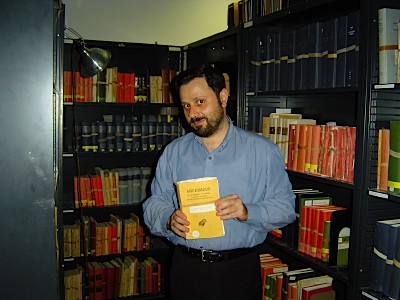
Sanskrit's very own monsterpiece comes in the Varadambika Parinaya by Tirumalamba. This blog post has cost me 30 bucks, but I have bought the edition of the poem:
- Suryakanta. 1970. Varadāmbikā Pariṇaya Campū of Tirumalāmbā. Volume 79 of Chowkhamba Sanskrit studies. Varanasi: Caukhambā Saṃskṛta Sīrīj Āphis.
Tirumalamba is one of the few women writers in Sanskrit, writing in the early 16th century; the work is a Campu, a mixture of prose and verse, on the marriage of her contemporary king Achyuta Deva Raya. On the literary merits of Tirumalamba's work, I'm not competent to speak, so I won't; if anyone from Karnataka finds this and wants to chime in, they're welcome to. If you do go googling for the text, btw, look for Tirumalamba, and not Varadambika Parinaya: there are lots of little annoying spelling variations for the book title.
Our word comes in pp. 18–19, in the chapter on the Tuṇḍīra country (aka Thondaimandalam in Tamil Nadu, of which the capital is Kanchi). The chapter reads:
On the way, he passed through the Tuṇḍīra country.The chapter takes up 130 lines of English translation.
The reason it takes up 130 lines is, "the Tuṇḍīra country" is preceded by 25 accusative adjectives, and followed by three more.
Those adjectives, in turn, take up several lines, and correspond to one or two sentences each in English. One or two LONG sentences.
The monsterpiece, which is only first among equals, is adjective #12. It's full of hyphens, so to my disappointment, I'm not going to destroy all the browsers in the world after all. I have taught myself enough Devanagari to type the word in, along with its translation and commentary.
I'm attaching a gif just in case, but after some initial confusion I think I did OK. The bad typography of the original was in fact helpful: the little gaps left between the vowels and consonants meant I could actually eyeball where the vowels were. The Unicode tables are missing one ligature of the edition (ङ्ग, which should look like a dotted ड्ग).
So, the Tuṇḍīra country is, among other things:

निरन्तरान्धकारिता-दिगन्तर-कन्दलदमन्द-सुधारस-बिन्दु-सान्द्रतर-घनाघन-वृन्द-सन्देहकर-रयन्दमान-मकरन्द-बिन्दु-बन्धुरतर-माकन्द-तरु-फुल-तल्प-फल्प-मृदुल-सिकता-जाल-जटिल-मूल-तल-मरुत्रक-मिलदलघु-लघु-लय-कलित-रमणोय-पानोय-शालिका-बालिका-करार-विन्द-गलन्तिका-गलदेला-लवङ्ग-पाटल-घनसार-करुतूरिकातिसौरथ-मेदुर-लघुतर-मधुर-शोतलतर-सलिलधारा-निराकरिष्णु-तदोय-विमल-विलोचन-मयू-रव-रेरवापसारित-पिपासायास-पथिक-लोकान्
nirantarāndhakāritā-digantara-kandaladamanda-sudhārasa-bindu-sāndratara-ghanāghana-vr̥nda-sandehakara-rayandamāna-makaranda-bindu-bandhuratara-mākanda-taru-phula-talpa-phalpa-mr̥dula-sikatā-jāla-jaṭila-mūla-tala-marutraka-miladalaghu-laghu-laya-kalita-ramaṇoya-pānoya-śālikā-bālikā-karāra-vinda-galantikā-galadelā-lavaṅga-pāṭala-ghanasāra-karutūrikātisauratha-medura-laghutara-madhura-śotalatara-saliladhārā-nirākariṣṇu-tadoya-vimala-vilocana-mayū-rava-reravāpasārita-pipāsāyāsa-pathika-lokān
[EDIT: restored the inherent /a/ before hyphens in the transliteration, per shreevatsa's comment. Check out his post on translating Sanskrit verse—and not just because it links here. :) ]
[UPDATE: Correction per Shreevatsa again:
निरन्तरान्धकारिता-दिगन्तर-कन्दलदमन्द-सुधारस-बिन्दु-सान्द्रतर-घनाघन-वृन्द-सन्देहकर-स्यन्दमान-मकरन्द-बिन्दु-बन्धुरतर-माकन्द-तरु-कुल-तल्प-कल्प-मृदुल-सिकता-जाल-जटिल-मूल-तल-मरुवक-मिलदलघु-लघु-लय-कलित-रमणीय-पानीय-शालिका-बालिका-करार-विन्द-गलन्तिका-गलदेला-लवङ्ग-पाटल-घनसार-कस्तूरिकातिसौरभ-मेदुर-लघुतर-मधुर-शीतलतर-सलिलधारा-निराकरिष्णु-तदीय-विमल-विलोचन-मयूख-रेखापसारित-पिपासायास-पथिक-लोकान्
nirantarāndhakāritā-digantara-kandaladamanda-sudhārasa-bindu-sāndratara-ghanāghana-vr̥nda-sandehakara-syandamāna-makaranda-bindu-bandhuratara-mākanda-taru-kula-talpa-kalpa-mr̥dula-sikatā-jāla-jaṭila-mūla-tala-maruvaka-miladalaghu-laghu-laya-kalita-ramaṇīya-pānīya-śālikā-bālikā-karāra-vinda-galantikā-galadelā-lavaṅga-pāṭala-ghanasāra-kastūrikātisaurabha-medura-laghutara-madhura-śītalatara-saliladhārā-nirākariṣṇu-tadīya-vimala-vilocana-mayūkha-rekhāpasārita-pipāsāyāsa-pathika-lokān]
| "It was, as if celebrating 134 the (important and) great festival of the marriage of the most suitable couple of the Goddess or Fortune and the Country, encouraged by the lovely lady in the form of the orange creeper, and the house-holder, the large garden, attractive with heaps of ripe yellow fruits, charming like numerous pellets of turmeric paste 135, set off in the silver cups of the buds of (her) bright flowers. It was admirable on account of thousands of groves of the coco-nut trees, that were richly laden with fruits and were, as if the hand of the earth, raised up to bestow the desired object on Indra's heaven, (which was) longing for her (of the Tuṇḍīra country) enviable 136 fortune. In it the beauty of the parting of the hair, filled with red-lead 137, of the young woman in the form of the earth was manifested 138 by the lovely path made 139 by the pollen to be seen in between the tall and densely grown trees that marked the lower limit of the range 140 of the rippling 141 rays of the sun. | 134. कन्दलत् —Lit. 'was producing'. 135. Lit. 'morsals of turmeric mud'. 136. Lit. 'longing' 'generating'. 137. This practice still exists in India. It is a sign of सुहाग (Skt. सौथाग्य), i.e. the husband being alive (or auspicious state of wifehood). 138. Lit. 'reminded'. 139. Lit. 'indicated'. 140. The trees were growing so very densely that the sun-beams could not penetrate through their branches. It seemed, as if the trees were the lower boundary of the field of activity of the rays of the sun. 141. Read वोचिक instead of विचिक. |
| In it, the distress, caused by thirst, to travellers was alleviated by clusters of rays of the bright eyes of the girls 142; the rays that were shaming the currents of light, sweet 143 and cold water charged with the strong fragrance of cardamom, clove, saffron 144, camphor and musk and flowing out of the pitchers 145 (held in) the lotus-like hands of maidens (seated in) the beautiful water-sheds, made of the thick roots of Andropogon muricatus 146 mixed with marjoram, (and built near) the foot, covered with heaps of couch-like soft sand, of the clusters of newly sprouting 147 mango trees, which constantly darkened the intermediate space of the quarters, and which looked all the more charming on account of the trickling drops of the floral juice, which thus caused the delusion of a row of thick rainy clouds, densely filled with abundant nectar." | 142. Lit. 'their'; in the Skt. passage the noun बालिका has already occurred. 143. Lec. var. मधु-रस-शोतल for मधुर-शोतल. 144. पाटल also means the trumpet flower, but as a rule, saffron is the companion of camphor and musk in Sanskrit literature. 145. Galantikā means a pitcher and is so called because water flows out of it (गलत्यम्थोऽरुयाः गलन्तिका). 146. लवुलय —roots of Andropogon muricatus, commonly known as khas. Huts made of the sweet scented roots of Andropogon muricatus (khas ki taṭṭis) are a regular luxury in the summer season throughout India. 147. कन्दलत् in the fourth line goes with माकन्द-तरु in line 6. This custom of spreading cloth in front for a distinguished personage to treads upon still exists in India and is practiced on both formal and informal occasions. But now-a-days the colour of this cloth is not white but red. It starts from the entrance gate of a hall or a canopy and leads right up to the dais. पाकारि Lit. 'the enemy of Pāka', i.e. Indra. |
...Read more


 Loading...


