2009-10-21

Lerna: Hitler finds out that the Greek language has no more than 200000 words

Travelling as I am in the U.S., I'm going to be light on blogging here at Hellenisteukontos (well, even lighter than usual); any blogging I do is going to be travelogues in The Other Place (once I'm somewhere worth traveloguing about.) But I've just found out that Stazybo Horn, honoured member of Team Fortier who has also stopped by and commented here, has taken That Downfall video, and subtitled it... with reference to the Lerna Myth. And a shout out to this Lerna thread! A blessing on your house, Stazy!

(To view Greek subtitles, turn on Closed Captioning, bottom right control next to Volume and Full Screen. My annotated translation into English follows.)

THEODORE ANDREAKOS,* Educ. Insp. (Ret'd), Hon. Prof. Tech Coll.: The longhairs* are counterattacking. They have occupied Wordpress and are heading towards Blogger. They include Sarantakos, Neostipoukeitos, and from the other flank Lexilogia and Periglwssio. From the eastern front, we have opuculuk,* nickel and yannisharis.Theodore Andreakos: prominent letter-writer in the recent debate in the Athens press over the word count of Greek.
longhairs: advocates of Demotic, from their bohemian appearance in the 1900s.
opuculuk: opuculuk.blogspot.com, URL of The Other Place, where Yr Obt Svt posts from.

ADOLF: Have Kounadis* attack them, with the ten million words.Antonis Kounadis: member of the Academy of Athens (representing Engineering), whose April talk on the gajillion words of Greek launched the whole Lerna saga in the Athens press and the blogosphere.
THEODORE ANDREAKOS, Educ. Insp. (Ret'd), Hon. Prof. Tech Coll.: Mein Führer... Kounadis...
EURIPIDES STYLIANIDES:* Kounadis is a laughing stock. They've reduced the word count to 200,000.Euripides Stylianidis: Minister for Education in 2008, taken in by the Lernaean Myth in a speech. Notoriously, the speech included a folk etymology of έντερο "intestine" as ἐντὸς ῤέω "I flow within"
ADOLF: ... The following will stay behind. Andreakos, Kounadis, Stylianidis, and Adonis-Spyros.*Adonis Georgiadis: Greek right wing politician, publisher, author, and TV host. Prominent in nationalist philippics on the Greek language. His original name is Spyros, and his critics delight in pointing out the affectation of his name change.
ADOLF: FUCK MY IN-TEST-INE!* We'd talked through Kounadis' mission! How did he manage to mess it up?! What do I keep collecting Liddel–Scotts for him for? You've forgotten all your graves and rough breathings*—I won't even mention your iota subscripts! You can't recite a single iamb in Aeolic!in-test-ine: See above, έντερο.
Graves and rough breathings: the polytonic accentuation system, a rallying point of linguistic conservatives after the disuse of Puristic Greek.

ADONIS GEORGIADIS: The man of many devices...*The man of many devices : the beginning of the Odyssey: Iambic in Modern Greek translation, at least.
ADOLF: We'd already got up to 120 million words!
ADONIS GEORGIADIS: Mein Führer, Euripy did try...
ADOLF: The TLG says as much! 5,000,000 words! Even English has overtaken us! What the fuck are you learning in your academies anyway? Just how to stick clubs up omegas' privates?* Sarantakoses and Tipoukeitoses! They should be impaled on the Colossus' torch! Hanged on the Themistoclean Walls! Them and Maria and Diver and Pi-Squared. And that Stazy.clubs up omegas' privates: A humorous verse in 1964 by Dinos Christianopoulos lamented that the abolition of iota subscript would deprive the Greek script of "its smallest obscenity": omega with iota subscript, ῳ, which looks slightly like a depiction of anal sex if your mind is dirty enough. With the iota subscript long abolished, the verse is routinely brought up in any discussion of the polytonic.
I never went to any academies. But I have glorified my language, by turning the world into mincemeat. Linguists! What did I sit and learn duals and infinitives for? 120 volumes,* I read them one by one. I even read about the God of the Jews.* He too was in my language. Millions of words; not one fewer! 120 volumes: As was pointed out in the letter-writing saga, if Greek really did have five million words, Liddell-Scott would have 120 volumes, not just one (or two, depending on the edition).
God of the Jews: The Septuagint is included in the TLG corpus.

SECRETARY: Hush, Lady Madonna...*Hush, Lady Madonna: Despina "Madonna" is a plausible first name, but this is an allusion to the folksong verse beloved of Greek irredentists: "Hush, Lady Madonna, and cry not so; after years and times pass, they will be ours once more." The song gave its title to Herzfeld's influential critique of the politicisation of Greek folklore
ADOLF: A pity I copied so much just to break my hand in.* Now where will I find 60 million terms? That's it. We've dipped the boat. Sarantakos has pulled our pants down. But if you think I'm going to start using monotonic accentuation, you're mistaken. I'd rather lick a kouros' "pears".* 200,000 words, he says...to break my hand in: An allusion to a comment by Cornelius, the polytonicist gadfly of Sarantakos' blog, that he used to voluntarily copy out polytonic texts in school "to break his hand in", gratified to find Babiniotis is now recommending the same. "My mother would say that was contrary to any paedagogical principle; I replied it was the monotonic system that was contrary."
pears: απίδια, euphemism for αρχίδια "balls"

...Read more

2009-10-13

The 23 to 29 Apolloniuses of Classical Literature

I'm parking this posting here for lack of somewhere else to park it. (It's not strictly language-related, but I'm realising philology posts are probably better pitched here than in The Other Place.)

In my day-job capacity, I'm posting on the fluidity of identity in repositories—how, particularly if you're relying on computer deduplication of identity, there will always be some tentativeness about who is identified as the same person. Repositories have to deal with that tentativeness, rather than hardcoding identity. This is an issue Wikipedia often comes up against, having to split off one article subject from another.

And I was reminded of the morass of Apolloniuses in Classical literature, particularly among medical authors. There are no less than potentially 13 medical authors we know of called Apollonius, according to the TLG Canon of Greek Authors and Works (3rd ed.). Potentially 13, potentially just 9; f.i.q. "possibly the same person as", appears several times in the listing:
(Note: links are to the Catalan Wikipedia.)

Our problem in working out who is who is that almost all of them are cited in passing in other medical authors, so we have very little to go on. The Online TLG Canon only represents works published under a distinct author's name, even if only as Testimonia. So it only refers to two of them, Of Citium and Mys. The other 11 authors also have Testimonia, in Galen and Oribasius and Alexander of Tralles and Aëtius, but they haven't been published independently.
So the 2009 Online Canon has more limited coverage of types of author than the 1990 Print Canon (though a longer time range). The Print Canon includes all ancient authors we know about. The Online Canon only includes those authors with texts represented in the corpus, and that is determined by an editor publishing text under that author's name. So if an Apollonius has been cited in Galen, and an editor publishes that citation as a Fragment of Apollonius, Apollonius will have an entry in the Online Canon, and will link to the published text in the corpus. If we only have secondary source material on the Apollonius from Galen, and an editor publishes that material as Testimonia on Apollonius, the Online Canon will still have an entry, because the point of the author entry is to navigate the corpus.

If OTOH an editor has never combed Galen for Apollonius, the Print Canon will still mention the Apollonius as cited in Galen (as a cross-reference), but the Online Canon will not have an entry for him, because it doesn't have a discrete text for him. That places the Online Canon notion of authors at the mercy of their editorial history; but the Online Canon is documenting edited texts.


The 9–13 medical Apolloniuses in the TLG Canon are joined there by 16 other Apolloniuses in Ancient literature:


The English Wikipedia knows of 16 non-medical Apolloniuses (but five of them are not in the list above), and no less than 21 physicians called Apollonius, since they're not restricted to medical authors. And Wikipedia is just as aware of the f.i.q. issue. The German Wikipedia's list has 24 Apolloniuses, and they don't seem to overlap completely with the English list. The Catalan Wikipedia's list wins, with 18 medical and 39 non-medical Apolloniuses. And its list is even less clean.

Even adding in places of birth, nicknames, and the genres they wrote in, there is difficulty in differentiating these Apolloniuses. If we had enough metadata on them, after all, instead of passing mentions in Galen, we wouldn't be seeing all those f.i.q. For 0741 Apollonius and 0739 Apollonius, we're reduced to distinguishing them by who else they might be confused with. And the medical Apolloniuses may all be obscure (only Of Citium gets his own English Wikipedia page); but the other Apolloniuses include a major Late Epic poet (0001), the founder of Western grammar (0082), a major figure in Roman religious history (0619), a primary source in Homeric scholarship (1168), and an important contributor to the development of 3D geometry (0550). If it wasn't for places of birth and nicknames, we would not know who we were talking about.

Things are slightly better now with the invention of surnames, and recording years of birth in the Library of Congress record. But only slightly: confusion is certainly still possible. There is now a profusion of identities that people write under in cyberspace; if anything, that's now making things even worse. But that's a topic for my day-job blog...
...Read more

2009-10-07

The Motley Word

I continue the random miscellanea postings with a website I did not know about, and stumbled on because of a posting I will write next week. The Motley Word (Παρδαλή Λέξη) is a crowdsourced dictionary for Greek dialects, like Urban Dictionary and its Greek counterpart, slang.gr

The Motley Word has all the poor quality you'd expect of a crowdsourced project without critical mass of participants; they don't even provide for correction yet. So it's not going to supplant the Academy's dialect dictionary, the Historical Dictionary Of Modern Greek, any time soon. Sure.

But that's harder to say when the Historical Dictionary hasn't budged past delta in twenty years. (I see there's at least funding to digitise their holdings.) And the glossaries of mainstream dialects, as opposed to the more distinct variants like Pontic or Tsakonian, have been pretty motley themselves.

More meta-importantly, the Motley Word shows that speakers of the dialects still care, and it's still a resource. A resource I'm going to make use of soon—here's a hint, but I haven't started writing yet, so shhhhh...

So: excellent work! (And thank God noone's done Tsakonian :-)

Heracleses of the Crown

I don't want to get into the habit of retweeting what other bloggers say, it was annoying enough when Instapundit and Atrios started doing it. I also don't want this blog to get *too* Classicist-friendly, because there's plenty of Modern Greece stuff to talk about that has nothing to do with The Antick Burden. But this novel form commented on at The Magnificent Nikos Sarantakos' Blog is too interesting not to pass on to Classicists.

(And yes, I get much of my material from Sarantakos. That's why I keep calling the blog The Magnificent. That, and I like establishing a private language; hence "The Other Place".)

One of Sarantakos' concerns is good language use. So he lampoons instances in the press or from politicians of bad language use. What good and bad language use is of course a prescriptive matter—and I have to say, I'm pretty much cured of the anti-prescriptivism of linguistic orthodoxy: prescriptivisms can have their own internal linguistic reality, and they certainly have a social reality. Prescriptivism in Modern Greek is complicated, like the language itself is. It's no longer about how Attic a form is; now it's about how vernacular a form is, how glaring a translationism from English it is, or how boneheaded a misapplication of Attic it is.

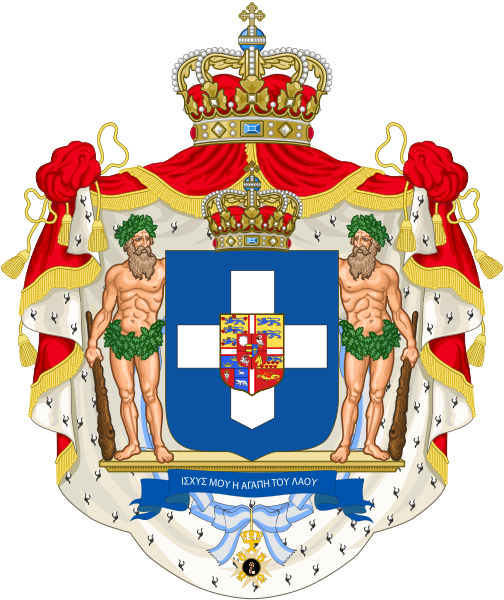
The "first linguistic gaffe after the elections", taken across by Sarantakos from a thread from Nikos Ligris in lexilogia.gr, was a politician's disparaging reference to two major members of the outgoing government. He called them The Heracleses of the Crown, using an established metaphor referring to the old coat of arms of the Kingdom of Greece:

But the plural of Heracles he used was not the Classical Ἡρακλεῖς. Nor was it the vernacular Ηρακλήδες.

(I've already posted on why that is the plural formation for vernacular first-declension nouns. Yes, Heracles is now first declension: the third declension is dead in the vernacular. And yes, that plural *is* historically still third-declension, because the declensions hybridised.)

No, the plural form the politician used was οι Ηρακλειδείς του στέμματος.

Now, Ἡρακλειδεῖς is in no way a plural of Ἡρακλῆς. It is a plural of *Ἡρακλειδεύς, and the -ιδεύς suffix on that word was used in antiquity to denote the offspring of an animal or a family member: ἀετιδεύς "young eagle", λυκιδεύς "young wolf", υἱιδεύς "son of a son", γαμβριδεύς "son of a brother in law". LSJ has one inanimate diminutive use in an inscription, θυριδεύς "little gate = window frame", and the most widespread use of the suffix is also diminutive rather than offspring: ἐρωτιδεύς "cupid, depiction of Eros [Cupid] in sculpture or painting". But there is no Ancient use of the suffix as a patronymic: the Offspring of Heracles are the Heracleidae, Ἡρακλεῖδαι.

It turns out though that the fans of Heracles FC, the oldest football club in Thessalonica, have taken to calling themselves Ηρακλειδείς. Amused by their claims to antiquity, rather than to actually winning championships, fans of Ares FC and PAOK FC have taken to calling them "The Old Ladies" instead.

So we can reconstruct what happened. An Attic plural Ηρακλείς in Modern Greek is hopeless: it is homophonous with the singular Ηρακλής [iraˈklis], and it uses a third declension noone has heard of. (They would especially not have heard of it because this particular declension pattern in -κλῆς is restricted to proper names, and plurals of proper names are rare.) A vernacular plural Ηρακλήδες is still felt undignified: you can use it about your cousins called Heracles, or to express contempt about the Heracleses and Theseuses of legend (and it sounds as clunky as Heracleses does in English); but the fans of Heracles FC would never refer to themselves so commonly.

(They would have decided that in the phone booth they meet in every Saturday, as an Ares FC fan might put it.)

Confronted with the lack of a useable *and* appropriate plural of Heracles, a Heracles fan a few years ago hit on the pattern of ἀετιδεύς "young eagle", and started people using Ηρακλειδείς. Ηρακλειδείς is in a third declension just as dead in Modern Greek, but at least somewhat more familiar via Puristic.

  • (As also noted in comments, the colloquial singular of that word is not Ηρακλειδεύς, but Ηρακλειδής. Because the third declension in -ευς is not *that* familiar.)
  • (E-fufutos [as he Englishes himself] says ἀετιδεύς is "familiar to all those who learned about 19th Century France via Puristic writers." Who was the French Eaglet?)

The Heracleses of the Crown in the coat of arms have always been Ἡρακλεῖς. The politician being interviewed racked his brain for a plural of Heracles—which as we saw, is awkward in Modern Greek. He remembered Heracles FC, made the association between ἐρωτιδεῖς "little cupids" and the little heraldic club-bearers, and blurted out Ηρακλειδείς. Some commenters to the thread admitted that they have done the same.

So, was this a gaffe? There's a disagreement in the commentary to the post.

Opinion 1 (Nikos Sarantakos, Nikos "Nickel" Ligris): Yes, it's a malapropism: an attempt to coin a la-de-da Classical plural that ends up stumbling on an unattested word that violates Classical norms, and has nothing to do with Modern Greek at any rate.

Opinion 2 ("Boukanieros", me, Tasos "TAK" Kaplanis): It's a new word, and it's adorable. The analogy with cupids is clear in this particular context, and the Classical norm of it not being attached to proper names is not relevant here.

Opinion 1: What's so "adorable" about a bastard learnèd form?

Opinion 2: There's been a lot worse in the Athens press than Ηρακλειδείς. The Heracles FC context makes it attested, at any rate.

Opinion 1: The bastard form Ηρακλειδείς is indeed now attested for the fans (my spellchecker does not underline it!) Can we at least leave alone the established word for the coat of arms?

Opinion 2: But they're wee little Heracleses on the coat of arms! [You'll see the vernacular diminutive, Ηρακλάκια, more than once in the thread]

Opinion 1: There's this notion that as soon as any fool launches some half-baked variant form online, we've got to annotate it and put it into our dictionaries, instead of "correcting" it. (There's those PC scare-quotes again.)

Opinion 2: Yup. [My Anglophone readers are nodding along heartily, but note that the social histories of English and Greek are very different, and distaste for prescriptivism in English does not have the same purchase in Greece.]

The thread is ongoing, although I think people are agreeing to disagree by now. (The thread is now being derailed to talking about the Orwellian names of the new government's ministries.) I don't remember this much disagreement in a thread about linguistic gaffes recently, and I think it is because Opinion 1 and Opinion 2 are analysing the form differently.

Opinion 1 considers it a mistaken stab at a plural of Heracles that coins a new word by mistake. Opinion 2 considers it a serendipitous coining of a new word, that can in some contexts stand in as a plural of Heracles.

Opinion 1 considers the coinage illegitimate, as pseudo-archaic Greek in a time when pseudo-archaic Greek is no longer welcome. Opinion 2 shrugs.

Nikos will defend Opinion 1 more cogently than I have done, I suspect, because there is context to notions of correctness in Modern Greek that I'm not fully presenting here...
...Read more

2009-10-06

Deictic force of Hellenistic demonstratives

Quick note: Ἐν Ἐφέσῳ notices from the linguistics literature that the meaning of demonstratives in Modern Greek depends on their position: αυτό το μπουτάκι "that-one the pork-joint" is more physical deixis ("that pork joint which I'm pointing at"), whereas το μπουτάκι αυτό "the pork-joint that-one" is more discourse deixis ("that pork joint which I mentioned before").

He considers this may shed light on the use of demonstratives in New Testament Greek—and commenter Carl Conrad notes this is already known of Classical Greek, complete with Smyth reference.

2009-10-05

Nastratios in Pagdatia

A thread last month at the Magnificent Nikos Sarantakos' Blog, about insulting commentary on a candidate MP from the Muslim minority, got derailed in comments (the way good comment threads do) into a discussion of whether there was any point teaching Ancient Greek in high school in Greece. The reason why Ancient Greek is taught in high school has to do with moral panic, rather than any concern over actually learning the language. That is why the age at which it is taught has become such a football; and the way Ancient Greek is taught is universally condemned.

Indeed, most commenters thought teaching Ancient Greek language at the expense of Ancient Greek literature *as literature* was unacceptable, and teaching Ancient literature in translation, as has occasionally happened, is much preferable. Some commenters conceded the usefulness of Ancient Greek in teaching grammar, but grudgingly. And I'll stay with this exchange:

Ηλεφούφουτος: ... Instruction should not give so much emphasis on reproducing grammatical forms (e.g. what is the 3rd person imperfect of ὑφίημι, or conjugate the verb in the second aorist middle optative.) All that, and syntactic parsing word for word, are fine brain exercises, but that's now how you'll learn Ancient Greek.

Μαρία: Who gives a f*ck about reduplication. But for students to recognise that this is a verb, an adjective, at least the parts of speech: that much is necessary. So they must be taught grammar, and you can't do that with little songs and little poems. Have you forgotten this isn't a living language?

I'm not contributing to that derailment—although I agreed there it was absurd that the students weren't being asked questions about the literary values of Antigone. In fact, the recommendations Ηλεφούφουτος was citing included "don't teach Ancient Greek through Antigone, you'll ruin Antigone for the kids." But I'm doing my own derailment, with the notion of little songs and little poems in learning Ancient Greek—that is, of teaching Ancient Greek in the engaging way schoolchildren learn foreign languages.

There is a textbook that does that: Paula Saffire & Catherine Freis. 1999. Ancient Greek Alive. 3rd ed. Chapel Hill: University of North Carolina Press.

Ancient Greek Alive has students act out skits, it has them doing question and answers with the teacher in Ancient Greek, and it has little stories in the target language, rather than starting with Real Text. In other words, it does what you normally do nowadays when you teach a foreign language. It would never ever be used in Greece, not only because of the profound malaise of Greek education, but because the relation of Greeks to their antiquity has always been too po-faced. It's the same reason, as I've posted in The Other Place, why a Greek will never affectionately parody their national anthem the way the Dutch do; and why a pastiche like Geoffrey Chaucer Hath a Blog will not lead to a Ἱστολογίζει Θουκυδίδης blog or a Λουκιανοῦ Διαδικτυακτοὶ Διάλογοι blog. At least not by a Greek.

(I beg someone to prove me wrong.)

I was reminded of Ancient Greek Alive because the earliest little texts it puts to the student are nothing to do with Ancient Greece. They are translations of tales of Nasrudin. Nasrudin is a comic figure from the Sufi tradition, who has made it into the folklore of many Muslim countries and their neighbours. His humour is somewhat subversive, and delightfully absurdist.

One of the neighbouring peoples Nasrudin's japes have gone across to are the Modern Greeks. He survives more in Cyprus than in Greece, but his humour has remained proverbial, in "the argument over the blanket" if nothing else—which has become a journalistic cliché. Nikos Pilavios' Greek Fairy Tale blog (I vaguely remember watching his TV show when I was a kid) has 36 Nasrudin tales, and an article about his own discovery of Nasrudin. Not all the tales are authentic, but authenticity doesn't mean that much with fairy tales. The journalistic cliché instance of a Nasrudin story, however, has been contributed there by a commenter:
Ενα βράδυ ο Ναστραντίν Χότζας κοιμόταν με την γυναίκα του. Ξαφνικά ξύπνησε από τις φωνές δύο ανθρώπων που καβγάδιζαν κάτω από το παράθυρό του. Σηκώθηκε, τυλίχτηκε στο πάπλωμα και κατέβηκε να δει τι συμβαίνει. Μόλις αυτοί τον είδαν, παράτησαν τον καβγά, άρπαξαν το πάπλωμα και έγιναν καπνός. Οταν η γυναίκα του τον ρώτησε γιατί καβγάδιζαν, της απάντησε: «Ο καβγάς ήταν για το πάπλωμα».
One evening Nastrandin Hodja was sleeping with his wife. Suddenly he woke to the shouting of two men arguing beneath his window. He got up, wrapped himself in his blanket, and went downstairs to see what was happening. As soon as they saw him, they quit arguing, grabbed the blanket and disappeared. When his wife asked him why they were arguing, he answered: "the argument was over the blanket".

Have you noticed what's happened to the name Nasrudin? It starts in Arabic as نصرالدين naṣr ad-dīn, "Victory of the Faith", which is a Muslim proper name. In Turkish, it's Nasreddin Hoca, Teacher Nasreddin. Greek now respectfully transliterates him as Νασρεντίν <Nasrentin>; but spoken Greek had no patience for /sr/ clusters, so traditionally he has been called Ναστραντίν Χότζας, <Nastrantín Chótzas>, with an epenthesis breaking up the /sr/.

I was reminded of Nastrantin, not because of the thread over at Sarantakos', but because I came up against the name in a different context. I've been going through the Prosopographisches Lexikon der Paläologenzeit, the Who's Who of Late Byzantium; and I've found that George Pachymeres mentioned a Nasreddin Mahmud, son of Muzaffer ed-din Yavlak Arslan, who died in the battle of Bapheus in 1302. Because written Greek had no patience for /sr/ clusters either, he is rendered as <Nastrátios>, with the same epenthesis:
Ἁλῆς γὰρ Ἀμούριος σὺν ἀδελφῷ Ναστρατίῳ τῷ παρὰ Ῥωμαίοις ἐπὶ χρόνοις ὁμηρεύσαντι, τοὺς περὶ τὴν Καστάμονα Πέρσας προσεταιρισάμενος, Ῥωμαίους κακῶς ἐποίει.
For Amurios Hales ["Amur" Ali Bey], with his brother Nastratios who had been a hostage with the Romans for years, joined the Persians [Turks] around Kastamon [Kastamonu], and did ill to the Romans. (p. 327 Bekker)

Hold on to that Hellenisation as <Nastratios>, we'll come back to it. It gets worse in the Palaeologan Prosopography, btw. Ducas mentions a Χατζιαβάτης, Haci Aivat. Not the same person as the Hacivat of Turkish shadow puppetry, but certainly the same Hellenisation in its Greek counterpart.

What possessed Paula Saffire to insert a Sufi jokester into an Ancient Greek textbook? You can read all about it at her website. The notion of a Turkish jokester turning up in an Ancient Greek textbook is, I think you can safely surmise, a notion some Greeks are likely to have issues with: one more reason you won't see Ancient Greek Alive taken up in Greece. More's the pity.

So far, I've cited Nastrantin in Modern Greek, and a different Nastratios in Byzantine Greek, but I haven't shown you how Saffire & Freis Greek Nasruddin in the textbook. Here's his first appearance, p. 28:
ἄνθρωπός τις βούλεται πέμπειν ἐπιστολὴν ταῖς ἀδελφαῖς ταῖς ἐν τῇ Βάγδαδ. ἀλλὰ οὐκ ἐπίσταται γράφειν τὰ γράμματα. αἰτεῖ οὖν Νασρέδδινον τὸν Σοφὸν γράφειν τὴν ἐπιστολήν. ὁ δὲ Νασρέδδινος λέγει αὐτῷ· «ὦ φίλε, οὐκ ἐθέλω γράφειν τὴν ἐπιστολήν. οὐ γάρ ἐστί μοι σχολὴ πορεύεσθαι εἰς τὴν Βάγδαδ.»

ὁ δὲ ἄνθρωπος λέγει «ἀλλὰ οὐκ αἰτῶ σε πορεύεσθαι εἰς τὴν Βάγδαδ. αἰτῶ σε μόνον ἐπιστολὴν γράφειν ταῖς ἀδελφαῖς μου.»

«οἶδα» ἀποκρίνεται ὁ Σοφὸς· «ἀλλὰ ἡ γραφή μου κακή ἐστι καὶ ἀνάγκη ἂν εἴη μοι πορεύεσθαι εἰς τὴν Βάγδαδ καὶ ἀναγινώσκειν αὐταῖς τὴν ἐπιστολήν.»

A man wants to send a letter to his sisters in Baghdad. But he does not know how to write the letters. So he asks Nasreddinos the Sage to write the letter. But Nasreddinos says to him: "Friend, I do not want to write the letter. I don't have enough time to go to Baghdad.

The man says, "but I'm not asking you to go to Baghdad. I'm only asking you write a letter to my sisters."

"I know," the Sage answers. "But my handwriting is bad, and I would have to go to Baghdad myself and read the letter out to them."

You may have noticed some things wrong. No, they have not taught the aorist yet, so everything is in the present tense; that's understandable, though it makes the story sound Pontic. (No, not Pontic as in the butt of Greek jokes, but as in the dialect that fails to make any aspect distinctions in the subjunctive.) I'm also not sure that's how you'd use οἶδα. But no, there's something wrong with the transliteration.

Not that they failed to use <Nastratios>: it would hardly be fair to ask that of them—although the fact that they, like contemporary Greeks, have patience for /sr/ clusters puts them at odds with what a Greek writer would actually have done.

But what sticks out, as many a Greek will tell you, is Βάγδαδ <Bágdad>. Greeks do not call Baghdad Bagdad /ˈvaɣðað/. They call it Βαγδάτη, <Bagdátē> /vaɣˈðati/. And they will become righteously indignant, as indeed I did when I bought the book. We met Iraqis centuries before the Beef-Eaters—and Theophanes Confessor called them Hērakîtai, Ἡρακῖται. Where do Saffire & Freis get off, ignoring what Greeks call Bagdad, and coming up with their own name? Don't we matter? Don't the Byzantines, who dealt with Bagdad, matter?

The sentiment has a certain sense behind it; to call Russians Ῥοῦσσοι instead of Ῥῶσσοι, as they do elsewhere (moving on to an anecdote about Napoleon) does seem a little disrespectful of Constantine Porphyrogenitus.

But I've already written a post on how Modern Greek Hellenisations are more antiquarian than Byzantine Hellenisations were. So how did those Byzantines actually call the city?
  • Theophanes Confessor (ix AD): Bágda
  • Apomasar (ix AD): Bagdân
  • Leo Choerosphactes (x AD): Bagdá
  • Constantine Porphyrogenitus (x AD): Bagdád
  • Theophanes Continued (x AD): Bagdá, Bagdád
  • Anna Comnena (xii AD): Bagdâ
  • John Scylitzes (xii AD): Bagdá
  • John Zonaras (xii AD): Bagdâ
  • Digenes Acrites (xiv AD): Bagdâ
  • Laonicus Chalcocondyles (xv AD): Pagdatíē, Pagdátin
  • Vernacular Astrological texts, Delatte: Codices Athenienses (? AD): Bagdádai, Pagdáti

The accentuation Βάγδαδ has never been correct: Saffire & Freis have carried across the Germanic stress position of English /ˈbæɡdæd/, whereas all but the first Greek transliteration reflect the stress of the Arabic بغداد‎ /baɣˈdaːd/.

But it turns out there is nothing Byzantine about the modern feminine form Βαγδάτη. The Byzantine forms are either variants of the feminine Βαγδά, the neuter Παγδάτι, or the quite indeclinable Βαγδάδ, with the hesitation between <b> /v/ and <p> /p/ typical of Late Byzantium. (Chalcocondyles' Homeric rendering of "Bagdadia", Παγδατίη, is the kind of affectation we'd expect of him.) I couldn't find out from my quick-and-obvious search when Βαγδάτη was first used, but it doesn't seem to be have been used by those who met Iraqis centuries before the Beef-Eaters.

Attempts to write Ancient Greek in Modern times, à la Neo-Latin, don't have a convenient name, through which the Ancient Greek Wikipedia can be banned by the Wikipedia Language Committee (grumble stick-up-their-arses grumble as-if-anyone-uses-Low-Saxon-as-a-primary-language-of-communication grumble grumble). We can't call them Neo-Greek, Neohellenic is what Modern Greek is called. Neo-Classical goes to Stravinsky—or Puristic. Neo-Attic is too specific, it leaves out the Astronautilia. Neo-Ancient?

Whatever it's called, Neo-Ancient Greek when it happens is indebted to Puristic: the Ancient Greek Harry Potter doffs its hat to 19th century dictionaries (and shies away once Demotic turns up in the lexica). The Neo-Ancient Greek Asterix doesn't doff its hat, admittedly. Then again, the Neo-Ancient Greek Asterix doesn't have to: it was translated in Greece (ingeniously), and Puristic seeps in there through the soil.
(The linked post notes that Asterikios in Ancient Greek didn't work well with Grade 7 students, who still struggled with the language—but that it did work when accompanied by the Modern Greek text in parallel. While we're on the subject: two interviews with the translator of Asterix into Ancient Greek, Fanis Kakridis: #1, #2.)

Saffire & Freis did not doff their hat to Puristic either, in telling tales of Napoleon or Nasrudin—even through they drafted the textbook on a beach in Crete. (Maybe Puristic doesn't seep through sand.) So their Russians are Ῥοῦσσοι instead of Ῥῶσσοι, because of English Russian, and their Nasrudin is Νασρέδδινος because of Turkish Nasreddin, not Modern Ναστραντίν. (It would have been unreasonable, I admit, to demand of them Mediaeval Ναστράτιος.)

In not writing Βαγδάτη, though, it wasn't the Byzantines they didn't doff their hat to, it was Puristic, and by extension Modern Greek. But of course, when Harry Potter uses Puristic words, it isn't because of love of Coray and Papadiamantis. It's because that's where he's going to get a word for train more compatible with Ancient Greek than the contemporary τρένο. Saffire & Freis had no such compulsion with Modern names.

The failure to epenthesise <Nasréddinos>, I'd still say, is a lack of sensitivity to Ancient Greek as a spoken language, which is ironic given how oral their textbook is. But the extremely unpleasant truth is, an American textbook of Ancient Greek owes Modern Greek speakers even less than it does to Constantine Porphyrogenitus. It doesn't owe them Βαγδάτη just as it doesn't owe them iotacism.

Still, if it owes the Hērakîtai anything, it's not Βάγδαδ. Like Constantine Porphyrogenitus said: it's Βαγδάδ.

P.S. Saffire has made the mistake of saying on her website: "Surely these are the only Sufi stories in ancient Greek!"

Them's fighting words:
ἀφικόντος γείτονος ἐπὶ τῆς πύλης Ναστρατίου τοῦ ἱερέως, ἐξέρχεται ὁ ἱερεύς ὑπαντῆσαι αὐτόν.
«δός μοι, ἱερεῦ, τὸν σὸν ὄνον σήμερον», αἰτεῖ ὁ γείτων. «ἔχω γὰρ ἀγαθά φορτία τινα μετακομῆσαι εἰς τὴν ἄλλην πόλιν.»
ὁ μὲν Ναστράτιος οὐ βούλεται δοῦναι τὸ κτῆνος οὕτῳ τούτῳ· ἵνα δὲ μὴ ἄξεστος φανῇ, ἀποκρίνεται·
«σύγγνωθι, ἀλλ’ ἤδη δέδωκα τὸν ὄνον ἑτέρῳ.»
αἴφνης ἀκούεται ὁ ὄνος ὀπίσω τοῦ τείχους τῆς αὐλῆς ὀγκώμενος.
«ἐψεύσθσης μήν μοι ἱερεῦ!» φωνεῖ γείτων. «ἤν, ὀπίσω τοῦ τείχους!»
«ποῦ δαὶ τοῦτά φῃς;» ἀποκρίνεται ὁ ἱερεύς βριμώμενος. «τίνα δὴ μᾶλλον πιστεύσεις, ὄνον ἢ τὸν σὸν ἱερέα;»

A neighbour comes to the gate of Mulla Nasrudin's yard. The Mulla goes out to meet him outside.
"Would you mind, Mulla," the neighbour asks, "lending me your donkey today? I have some goods to transport to the next town."
The Mulla doesn't feel inclined to lend out the animal to that particular man, however; so, not to seem rude, he answers:
"I'm sorry, but I've already lent him to somebody else."
Suddenly the donkey can be heard braying loudly behind the wall of the yard.
"You lied to me, Mulla!" the neighbour exclaims. "There it is behind that wall!"
"What do you mean?" the Mulla replies indignantly. "Whom would you rather believe, a donkey or your Mulla?" (via Wikipedia)

I welcome chastisement of my Neo-Ancient Greek in comments. Well, chastisement within reason...

[EDIT: I got better than chastisement from William Annis; I got an improvement. In iambics after Babrius. I'd pardon his violation of Porson's Law, but my command of Ancient Greek is so lacking—let alone metrics—that I cannot but reverently cede the floor to him:]

γείτων τις αὐλῆς ἦλθε Ναστρατίου πύλην,
ὁ δ’ ἐκτὸς ἦλθεν ἀσπάσασθαι γείτονα.
“βούλοι’ ἂν, ἱερεῦ,” δεόμενος ἔφη γείτων,
“τῇδ’ ἡμέρᾳ μοι τὸν ὄνον ἐνδοῦναι τὸν σόν;
εἰς γὰρ πόλιν πρόσοικον ἐμπολὰς οἴσω.”
ἀλλ’ οὔτ’ ὄνον βουλόμενος ἐνδοῦναι κείνῳ,
οὔτ’ εἰκέναι γ’ ἄγροικος, ἠμείφθη λέγων,
“σύγγνοιαν ἴσχ’, ὦ γεῖτον, ἄλλῳ γὰρ πόρον.”
τείχους δ’ ὄπισθ’ ἔκλαγξεν ὄνος εὐθὺς μέγα.
“ἔψευδες ἄρα μοι,” φὰς ἐβόησεν γείτων,
“ὧδε γὰρ ὄνος πάρεστι!” ἱερεὺς δ’ ἤχθετο·
“πῶς οὖν λέγεις,” ἔλεξε, “τίνι δῆτα πείθου;”
...Read more